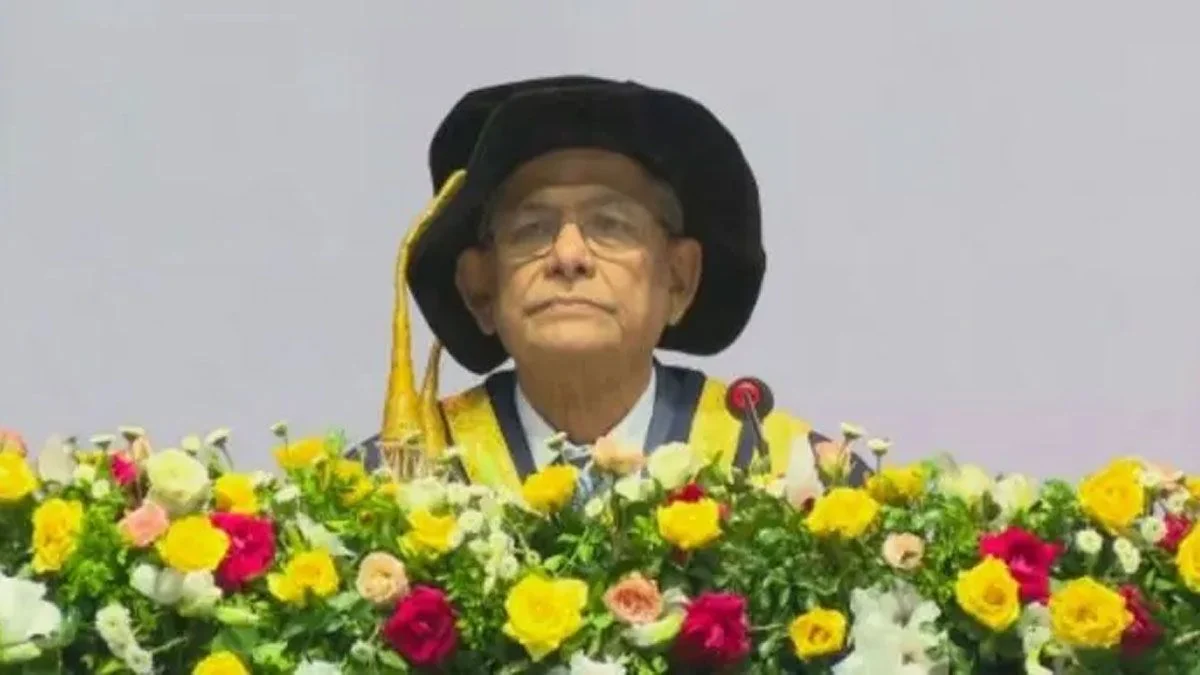
President Mirza Fakhrul Islam Alamgir has stressed making Bangladesh’s education system timely, job-oriented and skills-based, while raising the quality of higher education to an international standard.
He said young people should be prepared not as a workforce that only chases jobs, but as skilled workers, entrepreneurs and creators of employment.
He was speaking on Tuesday (November 10) at the 27th convocation of Independent University, Bangladesh (IUB), held at the Bangladesh-China Friendship Exhibition Centre in Purbachal, Dhaka.
The president said rapid advances in science and technology are changing how people live, the economy and the nature of employment. New technologies such as artificial intelligence (AI), biotechnology and robotics in particular are bringing sweeping change to the world of work. As a result, the knowledge and skills used for work today may need to be replaced with new skills within a few years.
Saying that an institutional degree alone is not enough in this situation, he said students must develop a lifelong desire to learn, the ability to think independently, problem-solving skills and the capacity to adapt to changing circumstances.
Congratulating the graduates, the president said their success rests on years of hard work, sacrifice and perseverance. He also thanked the teachers, parents and family members who contributed to their success.
Referring to the student-led mass uprising of 2024, the president said students of Independent University and other private universities and institutions played a brave role in the movement against fascist rule. He paid tribute to their contribution.
Setting out the measure of higher education, the president said that more universities or more degree holders alone do not guarantee success in education. Rather, the quality of teaching, an up-to-date curriculum, skilled teachers, students’ practical knowledge and competence, and the opportunity of decent employment determine a university’s real success.
Saying that the country’s education system had been badly damaged over the past decade and a half, he said permission had been given to set up various universities without proper scrutiny. As a result, many substandard institutions have produced educated unemployed graduates and held back the potential of a vast number of young people. Some young people have sunk into despair, and some have turned to drug addiction. This has wasted talent and potential both for individuals and for the state.
He added that many universities have strayed from the true purpose of education and become centres of business and excessive profit. This must change urgently.
Calling for an end to the divisions and inequality in the education system, the president said there have long been wide gaps in opportunity, quality and skills between the country’s different streams of education. An acceptable solution to these inequalities must be found. Building an integrated national education system by bringing the different streams together is the need of the hour.
Mirza Fakhrul stressed raising the quality of education to an international level so that the country can compete with the world. He cautioned, however, that the country’s own history, language, literature, culture and heritage must not be ignored. The president urged students to use the world’s knowledge and experience while keeping their bond with their roots intact.
Highlighting the need to align higher education with the demands of the labour market, he said universities must pay more attention to designing and implementing up-to-date, skills-based curricula. Alongside theoretical education, opportunities for practical and technical education, workplace experience and technological skills must be expanded. That way students can be developed into skilled human resources.
বাংলায় মূল প্রতিবেদন পড়ুন · Read the original Bengali report