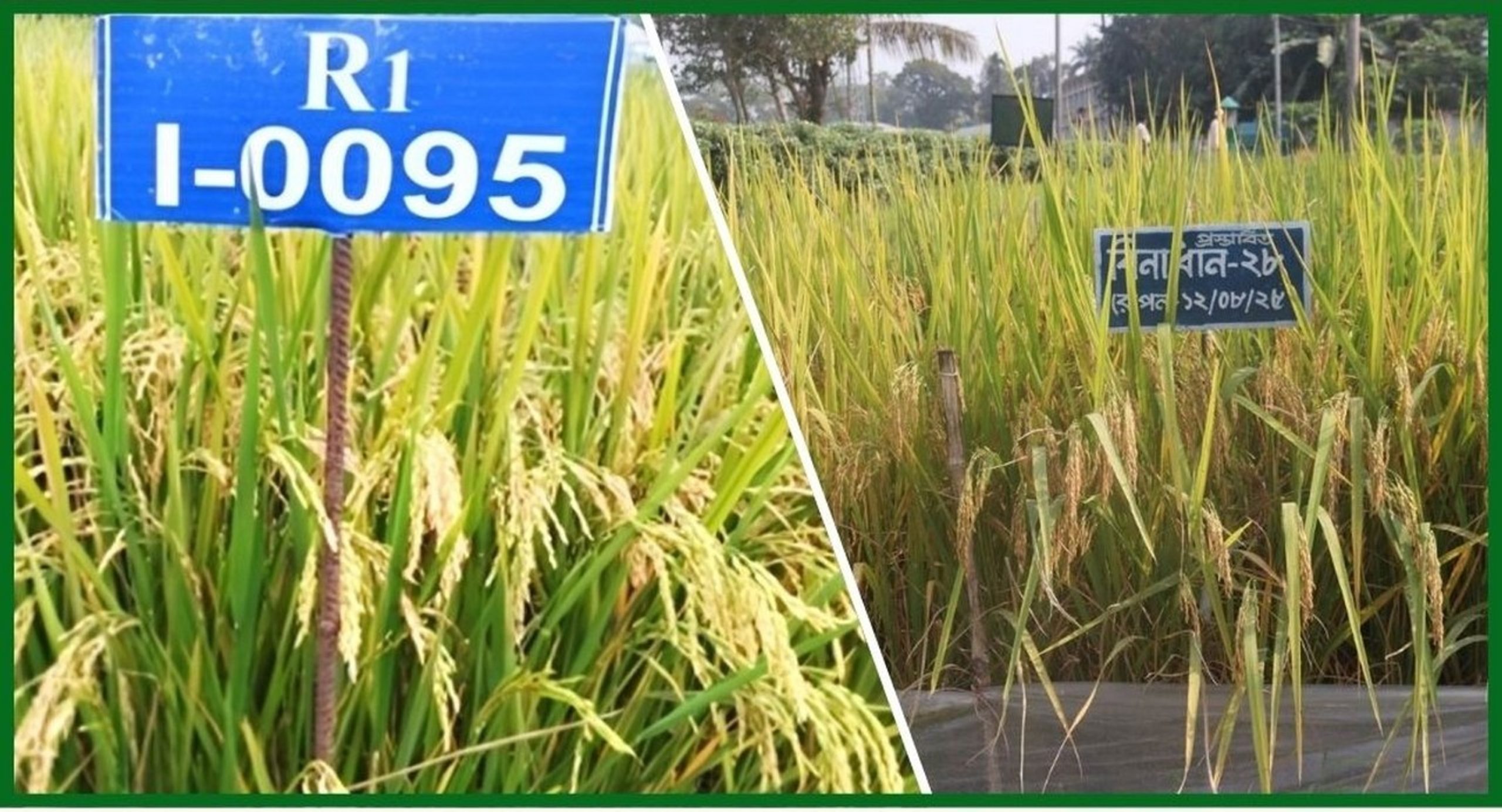
DHAKA — The Bangladesh Institute of Nuclear Agriculture, known as BINA, has developed two new varieties of aman rice that combine high yields, resistance to blast disease and improved nutritional content, officials said.
The varieties, named Bina Dhan 27 and Bina Dhan 28, were formally approved for nationwide cultivation at the 115th meeting of the National Seed Board recently held at the Agriculture Ministry, the officials said. The approvals raise the total number of rice varieties developed by BINA to 28. A research team from BINA’s Plant Breeding Department developed the two varieties.
Bina Dhan 27 has been recognized as the country’s first blast-resistant, high-yielding aman rice variety, addressing one of the most significant threats to rice crops. Plant breeders incorporated two effective resistance genes known as Pi-9 and Pish, which will significantly reduce damage caused by blast disease, officials said.
Dr. Fahmina Yasmin, head of BINA’s Plant Breeding Department, said Bina Dhan 27 has a life cycle of 120 to 125 days and plants grow 95 to 100 centimeters tall, making them less likely to fall in heavy winds. Average yields range from 6 to 6.5 tonnes per hectare, and up to 7 tonnes per hectare can be achieved in favorable conditions, she said. The variety produces about one to 2.5 tonnes per hectare more than conventional varieties, she said, adding that it will also help address nutritional gaps in rice-based diets.
On Bina Dhan 28, Yasmin said the aromatic, medium-fine grain variety is suitable for aman season cultivation and could generate strong interest among farmers. Developed using marker-assisted backcrossing, the rice contains 24.83 milligrams of zinc per kilogram, she said. The zinc-rich rice could be a boon for children’s intellectual development and for meeting the nutritional needs of pregnant women, she said.
Dr. Md. Mahmudul Hasan, principal scientific officer in the same department, said Bina Dhan 28 is a high-yielding, aromatic and medium-fine grain aman rice variety developed using advanced hybridization and marker-assisted backcrossing. “We believe it will prove highly promising for both farmers and consumers and will open new horizons in the country’s food and nutritional security,” he said.
The variety has a life cycle of 120 to 125 days and an average yield of 6.5 tonnes per hectare, Hasan said. Its amylose content of 27.42 percent gives the rice a fluffy, tasty texture, he said. Despite being aromatic, the variety requires no additional management practices, reducing production costs, he said, adding that it could gain popularity in the market as “the poor man’s pulao.”
Dr. Md. Shariful Haque Bhuiyan, the BINA director general, said Bina Dhan 28 is a groundbreaking addition to the country’s agriculture sector as the highest-yielding aromatic aman variety. With photoperiod insensitivity, high yield, nutritional value and aroma, the variety will play an important role in raising farmers’ incomes, ensuring consumer nutrition and filling the supply gap in the aromatic rice market, he said.
বাংলায় মূল প্রতিবেদন পড়ুন · Read the original Bengali report