RAJSHAHI — “Everything ended before I could bring my radishes to market — this land is now just water and more water.” Standing in front of his field on Friday morning, farmer Rabbani Mondal of Shiyalbed village in Paba upazila spoke with tears in his eyes. Knee-deep water lapped at his feet. Land once full of radish plants now lies submerged in rainwater.
Unseasonal rain since early November has left similar scenes in farm fields across Paba, Mohonpur, Bagmara, Tanore and Godagari upazilas of Rajshahi. Thousands of farmers in the district are now facing heavy losses from two days of rain. Crops from leafy greens to chilies, radishes, onions and even Aman rice have been damaged.
According to the agriculture department, losses stand at about 10.27 crore taka (about $830,000), with about 4,200 farmers affected. Two days of rain damaged crops on 2,150 bighas of farmland in the district.
In reality, both the number of affected farmers and the scale of the losses are likely higher, the department said. Farmers said they had not seen rain like this at this time of year since 1986. At Shiyalbed village in Paba upazila on Friday morning, Mondal said: “This kind of rain doesn’t even happen in Ashar (June-July) anymore. The water still hasn’t drained. Five bighas of my land are underwater. There are ponds on all sides — there’s no way for the water to run off.”
“If the government stands by us, we can get back on our feet,” Mondal said. “Otherwise it will be very hard.”
The same picture is visible across Shiyalbed, Paikpara, Dadpur and Murariypur villages of Paba upazila. As far as the eye can see, fields are still flooded. In some places, rice plants have flattened. In others, leafy vegetables lie underwater. Shahidul Islam, a farmer of Paikpara village, said: “I grew vegetables on 12 kathas of land. The rain destroyed it all. Rain doesn’t happen this time of year.”
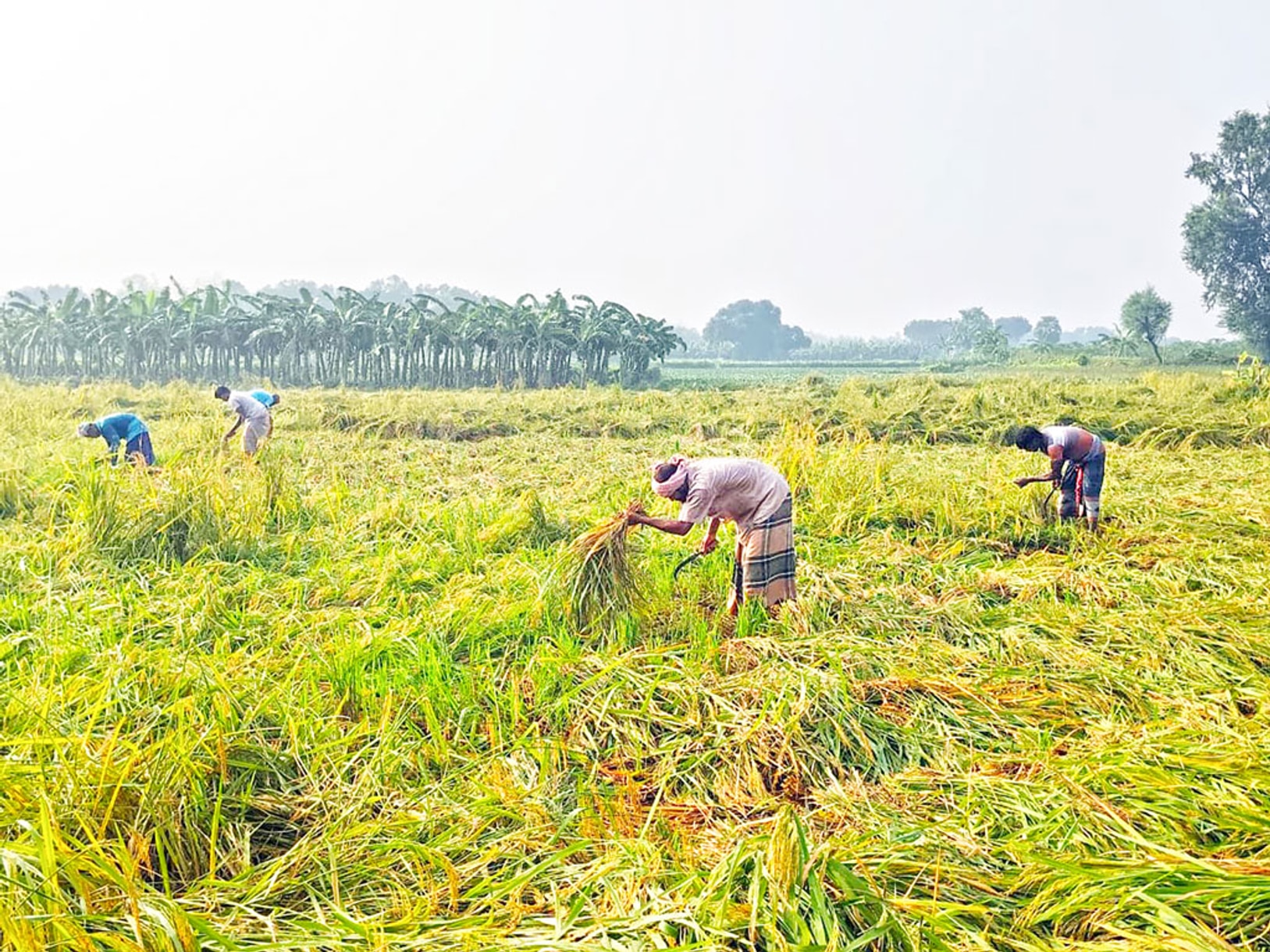
Abdur Razzaq, another farmer from the same area, planted BR-17 rice on one bigha of land. Before he could harvest it, the unseasonal November rain flooded his land and the wind flattened the rice plants. In the field, farmers were cutting the bent rice plants out of the mud. Razzaq’s son, Sohanur Rahman, said: “Half the rice will be lost. Labor costs will be high. I don’t think we’ll even cover the cost of cutting it. If the rain had come three days later, this disaster wouldn’t have happened.”
M.A. Mannan, Paba upazila agriculture officer, said the early November rain was mainly caused by a low-pressure system. Affected farmers are being given free seeds and fertilizer under an incentive program.
“We are advising farmers in the fields to drain their land quickly so they can plant new crops,” Mannan said.
Mohammad Nasir Uddin, deputy director of the district agriculture extension department, said crops on 2,150 bighas of farmland in the district had been damaged by the rain. Losses are about 10.27 crore taka. Information on affected farmers has been sent to the ministry in Dhaka. Incentives will be distributed when they arrive, he said.
বাংলায় মূল প্রতিবেদন পড়ুন · Read the original Bengali report