Prime Minister Tarique Rahman has not stopped at announcing more use of solar power: solar panels on the roof of his home in Gulshan have produced electricity of which he has used 1,000 units and supplied 1,200 units to the national grid, State Minister for Local Government, Rural Development and Cooperatives Mir Shahe Alam has said.
The prime minister set an example by producing and using this much solar power over the past three days, he said. Arrangements will be made for the roofs of all national buildings, starting with the Cooperative Bhaban, to meet their own needs and supply solar power to the government, and power generation should be seen as a business, he added.
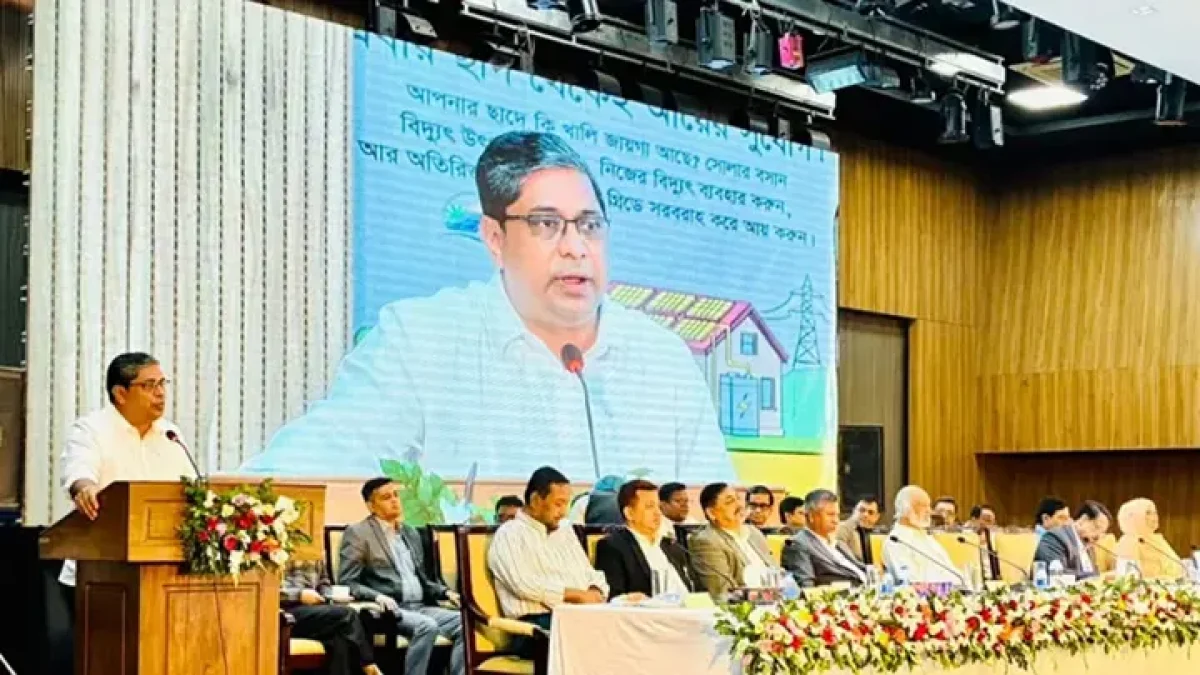
He was speaking on Saturday at a meeting on solar power, dengue prevention and development programmes with all upazila nirbahi officers (UNOs) and deputy directors (local government) at the Cooperative Bhaban in Sher-e-Bangla Nagar, Dhaka. Local Government Minister Dr Abdul Moyeen Khan and State Minister for Public Administration Md Abdul Bari also attended.
Urging UNOs to be alert to the risk of unrest before Durga Puja, he said no disorder must be allowed. UNOs have been told to do everything they can to make local government elections free, fair and impartial, with the government’s full support, he said.
Poor people come to UNOs for help, he said, so each UNO should have a discretionary fund to give immediate assistance of Tk 2,000 to Tk 5,000; if the public administration ministry cannot provide it, the local government ministry will allocate money from its revenue. He also said net metering for solar power should be settled with upazila administrations.
Important government projects, including farmer cards, family cards, imam and muezzin cards and canal digging, are being carried out under UNOs’ supervision, he said, suggesting an annual conference of UNOs, like the deputy commissioners’ conference, so upazila needs could be put directly to the prime minister.
The BNP government is a people’s government that believes in women’s empowerment, he said. Under the autocratic regime many officials lost their jobs for following government orders, but the BNP government would not ask anyone to hold “votes at night” or dummy elections. He said the BNP had also begun taking political action: after the Mirpur incident the north committee was dissolved and the MP was told to resign, and the government would not take responsibility for an MP’s personal conduct. He also stressed treating river and pond water to supply safe water and ease pressure on groundwater.
বাংলায় মূল প্রতিবেদন পড়ুন · Read the original Bengali report