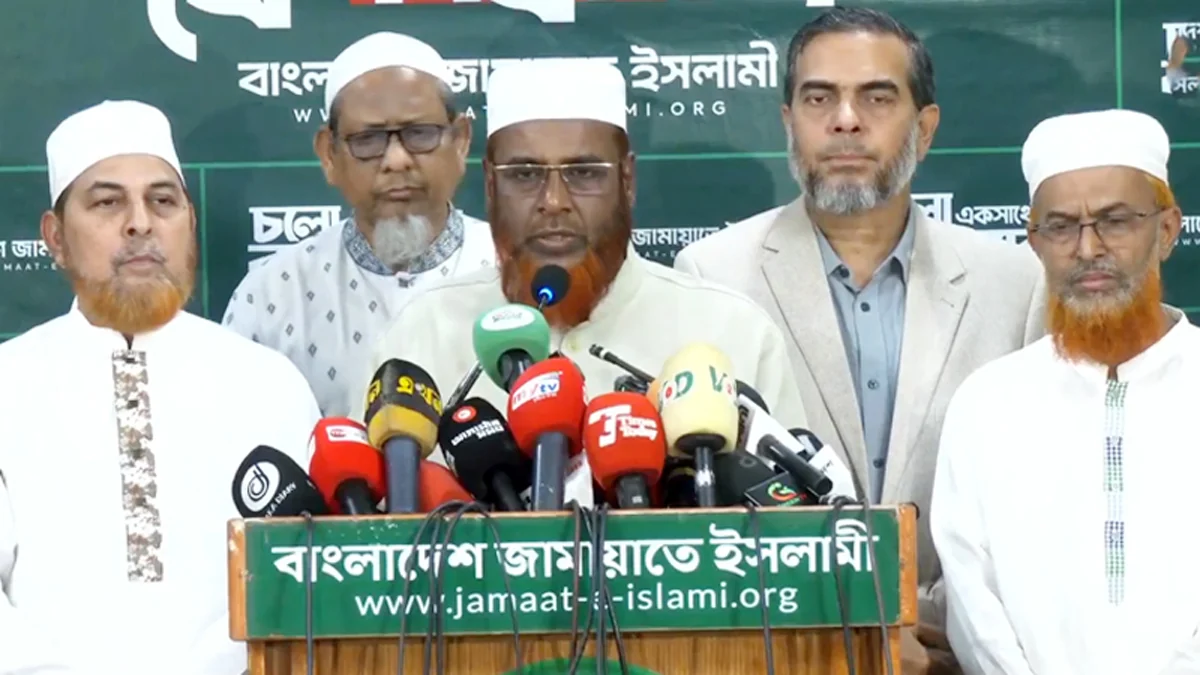
Jamaat-e-Islami Secretary General Mia Golam Parwar has said his party will cooperate with the government if it announces acceptance of the referendum result.
He said accepting the public verdict would ease the political crisis and restore trust in the government. He spoke at a news conference at Jamaat’s central office in Moghbazar, Dhaka, on Wednesday afternoon, November 18.
The party’s central executive council held an emergency meeting at 11 a.m., chaired by Jamaat chief and parliamentary opposition leader Dr. Shafiqur Rahman.
Parwar said the meeting discussed law and order, political conditions, insecurity over lives and property, and public concerns about independence and sovereignty. He said Jamaat had considered its responsibilities as a democratic political party and Parliament’s main opposition.
He accused the government of moving toward one-party authoritarian rule by disregarding the February 12 referendum result. The council believed that had created political uncertainty and instability, he said.
Political parties had reached agreement on and signed the July Charter, and nearly 70% of voters subsequently supported it in the referendum, Parwar said. He accused the ruling party of ignoring that mandate.
He said the government’s stance toward the verdict of nearly five crore people had undermined public trust. Agreeing to a charter and rejecting it after taking power amounted to political double standards, he said. Accepting the result could substantially resolve the crisis.
Parwar expressed concern about recent violence. He alleged that unrest had occurred in Gopalganj, Faridpur, Bhanga, Narail, Pirojpur and elsewhere after an announcement that Sheikh Hasina would return to Bangladesh.
He alleged that roads had been blocked with felled trees, vehicles stopped and searched, people beaten, and homes and shops attacked or set on fire. Jamaat lawmakers’ homes had also been attacked and burned, he said.
He further alleged that mosque loudspeakers had been used to summon attacks on police stations and that suspects had been taken from custody. Police had been attacked and their vehicles vandalized, leaving them unable to perform their duties, he said.
Parwar contrasted those allegations with the home minister’s statement in Parliament that law and order remained normal. Protecting lives, property and state facilities was the government’s and Home Ministry’s responsibility, he said, arguing that they were not fulfilling it adequately.
If important state institutions failed in their duties, the president should act as the state’s guardian, he said. He also called on constitutional officeholders to act if the government failed.
Parwar alleged that government weakness and deliberate actions by some officials were enabling efforts to rehabilitate the Awami League. He said people associated with what he called fascism remained in the administration, police, judiciary and constitutional offices.
He said Jamaat was receiving reports that Awami League members who had fled across the border were returning, and urged the government to identify them and take lawful action.
Calling for unity to protect independence, sovereignty and opposition to fascism, Parwar said Jamaat would hold programs throughout December. He announced a rally and protest march against violence in Dhaka on Saturday the 21st. Details of the monthlong programs would be announced at a later news conference.
He called on other political parties and forces opposed to fascism to announce their own programs, and urged people to remain calm while protesting violence.
Parwar said Jamaat had already held long marches, rallies and other programs to press for implementation of the July Charter and acceptance of the referendum result. These included a long march from the capital to Karimganj to build public support, he said.
With Wednesday the final day of the parliamentary session, he said people expected a clear message from the prime minister’s closing speech on resolving the charter and referendum dispute. Political crises should be resolved in Parliament rather than through street confrontations, he said.
“Let the government simply announce that it accepts the verdict given by 70% of people in the referendum. Jamaat will then withdraw all its ongoing programs,” he said. The government and opposition could then work together through parliamentary procedures to implement the constitutional reforms approved in the referendum.
However, he clarified that he was not presenting acceptance of the result as a formal condition attached to an offer of cooperation. Answering a question, he said neither the government nor the ruling party had formally sought Jamaat’s cooperation. Statements circulating on social media could not be treated as an official proposal, he said.
He urged the government to restore trust by accepting the verdict, arguing that resolving the political crisis would help address other difficulties.
Parwar also expressed concern about garment-sector unrest. Alongside workers’ demands, Jamaat believed there was incitement behind the violence, he said, alleging that a group wanted to damage industry and the economy.
He urged employers to ensure fair wages while protecting factories. Workers’ legitimate demands and industrial interests needed to be reconciled because workers, industry and the country depended on one another, he said. Jamaat was ready to help resolve the unrest.
Asked about the Awami League’s possible return, he said Jamaat would not support bringing it back. The party was watching for signs that the government might be facilitating such a return, he said.
Asked about joint street action with the BNP, Parwar said the parties were separate: the BNP was governing and Jamaat was in opposition. Jamaat remained united with patriotic citizens against fascism and domination and was acting from its own position in Parliament and on the streets, he said. It had made no new declaration of alignment.
The emergency council meeting was attended by Rahman, deputy chief ATM Azharul Islam, Professor Mujibur Rahman and other central executive council members.
বাংলায় মূল প্রতিবেদন পড়ুন · Read the original Bengali report