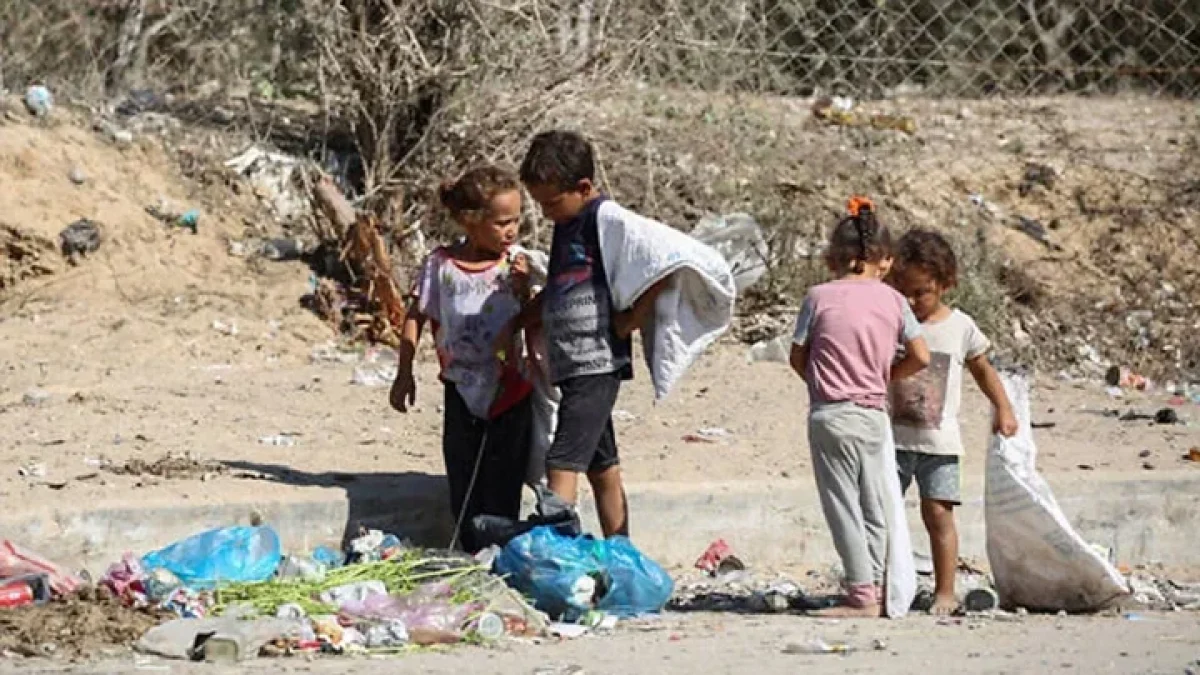
At least 71,000 children in Gaza have been orphaned by Israel’s military attacks and genocide, and at least 64,000 women have lost their husbands. About 3,000 of the children have no registered guardian, no one responsible for them and no one to look after them. Amid the rubble, poverty, displacement and shortage of shelter, the lives of these children and women are growing more uncertain.
Middle East Eye, a London-based outlet covering the Middle East, reported that according to Gaza’s Ministry of Social Development, 54,468 children have lost one or both parents since the Israeli genocide began in October 2023. The overall figures of 71,000 orphans and 64,000 widows also include people who lost a husband or parents in Israel’s military attacks on Gaza in earlier years.
The scale of the orphan crisis shows in the lives of three siblings, a 16-year-old girl, a 14-year-old girl and a 12-year-old boy, who move from one aunt’s tent to another’s every two days. They lost their father in Israel’s military operation in Gaza in 2014. When their home in Gaza City was destroyed in the attacks that began in 2023, they took shelter with their mother in a makeshift tent in Deir al-Balah in central Gaza.
On the 19th day after the ceasefire took effect on 10 October 2025, an Israeli bomb hit their tent. Their mother was killed in front of the three children. The youngest, the boy, was injured. He was sitting in his mother’s lap when the blast came.
The children are cared for by their mother’s sisters. Two of them also lost their husbands during the genocide and are raising their own children alone. One of the aunts, the widow Warda al-Mujaini, told Middle East Eye that the children have no permanent place to stay and spend two nights with each aunt in turn. “We try to help them cope emotionally, especially the youngest. He watched his mother die in front of his eyes,” she said.
Mujaini also lost her husband in an Israeli air strike. She has four children. With no job or reliable income, she struggles to find even one meal a day. “My other widowed sister and I are struggling to feed our own children. But we also have to look after our sister’s children, because they have no one else,” she said.
The three sisters do what they can for the children. One buys them pyjamas, another sandals, another gives them pocket money for a few days.
The risk of losing school and childhood
Aziza al-Khalut, a spokeswoman for Gaza’s Ministry of Social Development, said orphans’ suffering does not end with losing their parents. They are also deprived of safety, care, education and a normal childhood, and many have to take on far more responsibility than their age allows. She warned that with the economic and humanitarian situation getting worse and too little shelter, orphans face a growing risk of dropping out of school and of early marriage. Poverty, displacement and the loss of the family’s earner are also raising the risk of child labour.
Women who have become their family’s only earner must provide for their children while raising them in the ruins of the war.
A whole family lost in five minutes
Some children in Gaza are the only surviving member of their family, with no parent, brother or sister left to share their grief. One is a girl who was 10 years old on 22 February 2024. She had gone to her uncle’s house next door to charge her father’s mobile phone. At that moment an Israeli air strike hit her family’s home in Deir al-Balah in central Gaza, killing her father, her mother and her four brothers and sisters.
The siblings killed were aged eight, five, three and nine months. She was slightly injured in the strike. She was taken to hospital but was not told at first what had happened to her family. Later her uncle came and told her they had died. Now 13, she told Middle East Eye: “In the blink of an eye I lost my whole family.”
She said it took her months to accept that she had lost everyone at once. At first she lived with her grandparents. She kept thinking that if she had been at home with her family during the strike, she might have died too. “For months I felt: if only I had been at home with them when the bomb hit! If only I had died with them!” she said.
She later began living with her uncle, his wife and their newborn baby. Their comfort helped her cope a little, but the emptiness left by her family did not go away. “They tried to help and comfort me. That eased my pain a little. But I know no one can ever take the place of my own family,” she said.
Officials at Gaza’s Ministry of Social Development warn that statistics alone cannot convey the real suffering of orphaned children and widowed women. Providing safe shelter, food, education and social support for people carrying the wounds of the war is now a major challenge.
বাংলায় মূল প্রতিবেদন পড়ুন · Read the original Bengali report