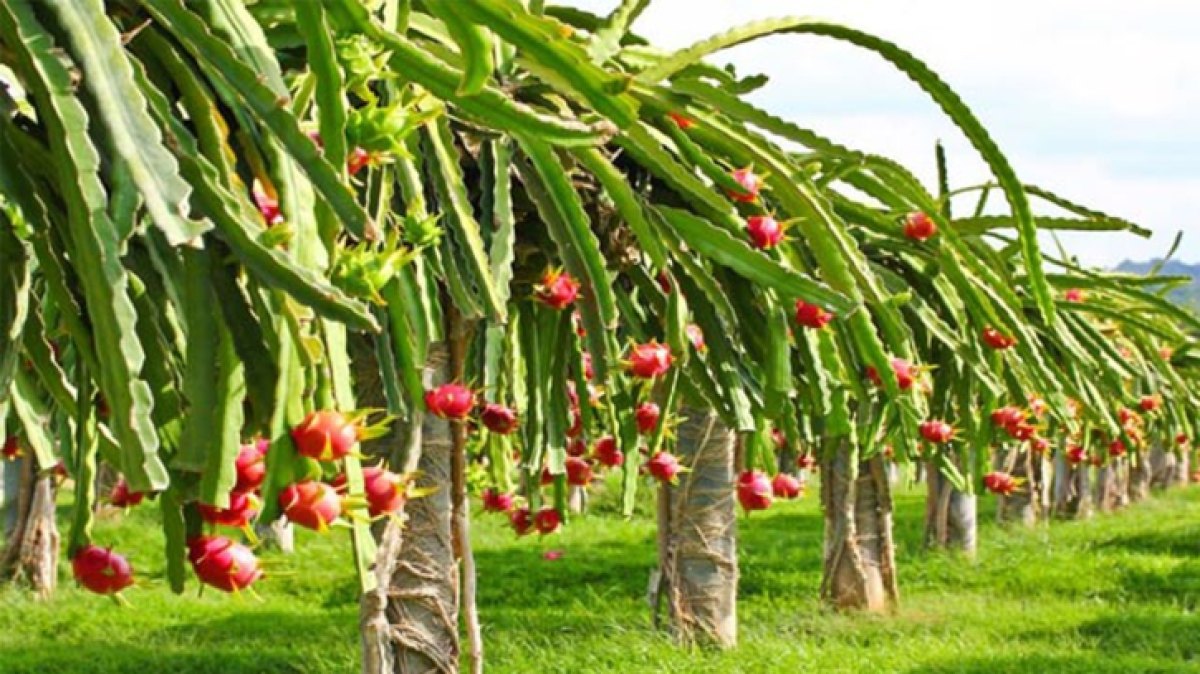
Dragon fruit is a nutritious fruit rich in vitamins, minerals, dietary fibre and antioxidants, and both its cultivation and market demand are growing in Bangladesh. It can be grown commercially anywhere from rooftop gardens to open fields. With proper knowledge of choosing the right variety, raising saplings, planting, setting up posts, managing fertiliser and controlling disease and pests, good yields are possible. Rafiqul Islam, sub-assistant agriculture officer of Jashore Sadar upazila, offers the following advice.
Dragon fruit is a type of cactus. It has quickly become popular because of its nutritional value and commercial potential. Raising domestic production would create an opportunity to increase farmers’ incomes and reduce dependence on imported fruit.
Dragon fruit is a warm-climate crop. Temperatures of 20 to 35 degrees Celsius are generally suitable, while excessive cold and frost harm the plant. It grows well in sandy loam and loam soils with a pH of 5.5 to 7.5. The varieties now grown in Bangladesh are BAU Dragon Fruit-1 and BAU Dragon Fruit-2. For a commercial orchard, the variety should be chosen with the local weather, soil type and market demand in mind.
Saplings are usually raised from stem cuttings. Cuttings 8 to 10 inches long should be taken from healthy, disease-free plants and left to dry in a shaded place for about seven days, so that the cut end dries out and the risk of rot after planting is reduced.
Saplings can be planted from mid-April to mid-October. The land should be ploughed and harrowed well until the soil is loose, and pits about 2 feet wide and 2 feet deep then dug. Before planting, 10 to 15 kg of cow dung, 200 grams of TSP and 150 grams of MOP can be applied to each pit. Where drainage is a problem, sand can be placed at the bottom of the pit.
Because the plant is a climber, it needs a strong post for support. RCC posts 8 to 10 feet long with a girth of 4 inches by 3 inches can be used, set firmly with about one and a half feet below ground. A tyre or a circular rod frame 1 to 1.5 feet in diameter is fixed at the top of the post. Four cuttings can be planted around each post, but the base of a cutting should not go more than 3 to 4 inches into the soil. After planting, the saplings should be tied loosely to the post.
With proper care and favourable conditions, plants can bear fruit about six to seven months after planting, though yield and the time taken depend on the variety, environment, care and management.
Dragon fruit orchards can be affected by anthracnose, root rot, stem rot and stem canker. When symptoms appear, the affected parts should be identified quickly and the necessary steps taken. To control disease, approved fungicides should be applied in the right dose and at the right time on the advice of an agriculture officer.
Water must not be allowed to stand in the orchard, as waterlogging raises the risk of root and stem rot. The orchard should be kept clean, and enough light and air should reach the inside of the plants.
The fruit can be attacked by thrips, mealybugs and fruit borers. Affected plants and fruit should be checked regularly at an early stage. Neem oil can be used when pests attack, and if the attack is severe an approved insecticide should be applied in the right dose on an agriculture officer’s advice.
Planting alone is not enough for a good yield. Regular weeding, proper fertiliser management, irrigation and drainage as needed, monitoring for disease and pests, and managing excess branches are all required, and the plants must get enough light and air.
As demand keeps growing because of the fruit’s nutritional value, there is scope to expand planned cultivation on rooftops, homesteads and suitable farmland. Higher domestic production would create a new source of income for farmers and reduce dependence on imports.
বাংলায় মূল প্রতিবেদন পড়ুন · Read the original Bengali report