Bangladeshi garment prices have continued to fall in major export markets, leaving manufacturers earning less despite shipping more products, according to trade figures and exporters.
The pressure has deepened in the United States and European Union, the country’s two main markets. Bangladesh is selling below global average prices and many competitors’ prices. Garment export earnings fell 4.57% in the U.S. market and 11.91% in the EU during the first nine months of this year.
Export-oriented manufacturers blamed dependence on basic garments, rising raw material costs and uneven domestic competition. They urged action before Bangladesh risks losing duty-free access after graduating from least-developed-country status. Market analysts said producers should prioritize higher-quality and more diverse clothing.
The Bangladesh Garment Manufacturers and Exporters Association (BGMEA) identifies the United States as Bangladesh’s largest single-country export market. It also describes Bangladesh as the second-largest garment exporter after the EU.
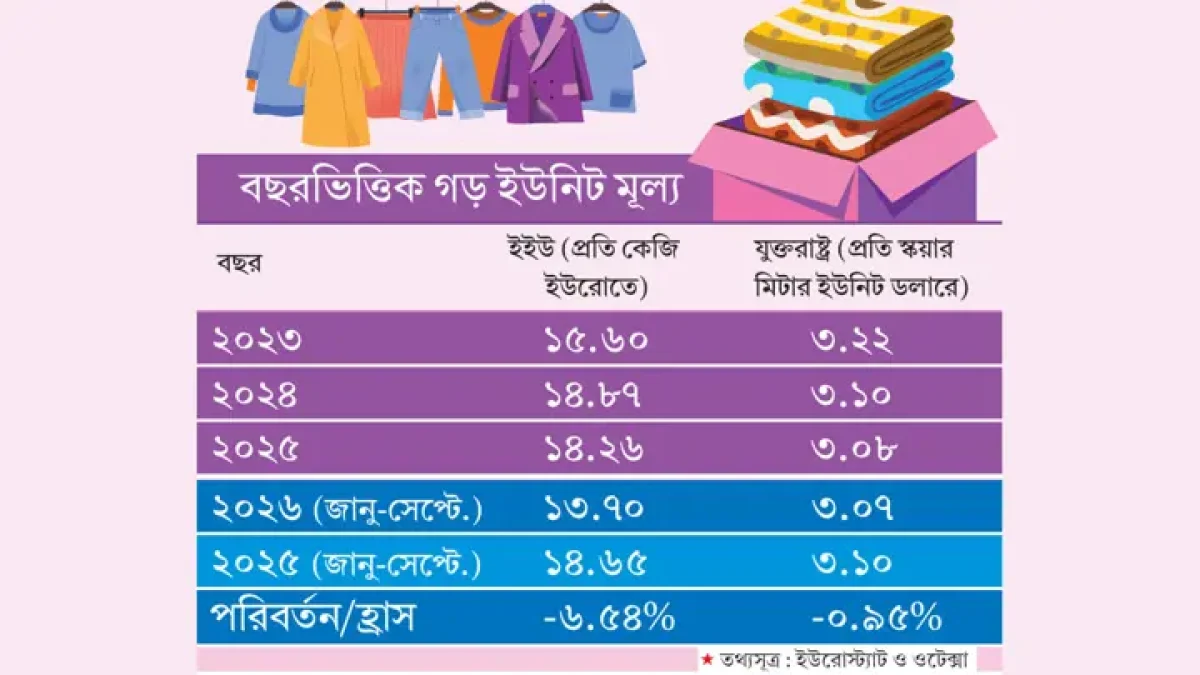
U.S. Office of Textiles and Apparel (OTEXA) figures show that Bangladesh’s average garment price per square meter fell 0.95% to $3.07 in January-September this year, from $3.10 in the same period of 2025. The average unit price of U.S. garment imports from all sources rose 2.14% to $3.18.
Among competitors, Vietnam’s unit price rose 1.25% to $3.59, Cambodia’s increased 0.52% to $3.04 and Mexico’s climbed 16.15% to $4.76. China’s fell 7.66% to $1.48 and India’s declined 1.88% to $3.44. Lower prices and weaker demand reduced Bangladesh’s U.S. export earnings by 4.57% to $613 crore 55 lakh.
The gap was larger in the EU, Bangladesh’s biggest export destination. Eurostat figures show that the average price per kilogram of Bangladeshi garments fell 6.54% year on year to 13.70 euros in January-September, from 14.65 euros in the same period of 2025. The EU’s average garment import unit price from all sources fell only 0.78%.
Vietnam’s unit price rose 8.18% to 28.58 euros, Cambodia’s increased 8.42% to 18.38 euros and Turkey’s rose 1.82% to 27.90 euros. China’s fell 1.80% to 19.69 euros, India’s declined 1.42% to 20.05 euros and Pakistan’s dropped 11.37% to 10.90 euros. Bangladesh’s export earnings in the EU fell 11.91% to 134 crore 77 lakh euros.
Eurostat and OTEXA figures show that Bangladesh’s average garment price in the EU fell from 15.60 euros per kilogram in 2023 to 14.87 euros in 2024 and 14.26 euros in 2025. It fell further to 13.70 euros in January-September 2026, below the global average of 19.59 euros in the EU market.
The U.S. market showed a similar decline. Bangladesh’s average price per square meter equivalent was $3.22 in 2023, $3.10 in 2024 and $3.08 in 2025. It slipped to $3.07 in January-September 2026, below the global average of $3.18.
Prices have also fluctuated. In the EU, Bangladesh’s average unit price was 16.17 euros per kilogram in March 2025 and fell to 12.89 euros that November, a high-to-low gap of 3.28 euros within the year. The gap so far in 2026 has been about 1.17 euros.
Exporters said rising raw material costs and the dominance of basic garments limited the prices Bangladesh could obtain. They also cited unhealthy and uneven competition among producers. Many factories were accepting orders at or close to production cost to keep operating, they said.
Basic products including T-shirts, polo shirts, trousers, sweaters and pullovers account for about 80% of Bangladesh’s garment exports, according to the Export Promotion Bureau (EPB).
Bangladesh exported $38.7 billion in garments in fiscal 2025-26. EPB and International Trade Centre figures show that non-cotton products accounted for 58.4% of global clothing demand in 2025, including garments made from synthetic fabrics and blended yarns. In contrast, 72.7% of Bangladesh’s garment exports were cotton-based, largely basic knitwear, T-shirts, trousers, sweaters and underwear.
BGMEA president Mahmud Hasan Khan said low- and mid-priced production was a major reason for low unit prices. Competitors other than Pakistan made relatively higher-value products, he said. Raising Bangladesh’s prices would require product diversification, better quality and stronger backward-linkage industries.
He said domestic capacity to produce raw materials based on man-made fibers and filament yarn needed to increase. Inadequate uninterrupted electricity and fuel supplies were major obstacles to new investment and expanded production, he said, and those problems had to be addressed to raise export prices.
Former BGMEA director Mohiuddin Rubel, chief executive of Bangladesh Apparel Voice, told Amar Desh that excessive dependence on basic products had long limited the industry’s growth. He urged producers to explore promising new markets rather than only seeking greater dominance in established ones, while diversifying beyond basic garments.
বাংলায় মূল প্রতিবেদন পড়ুন · Read the original Bengali report