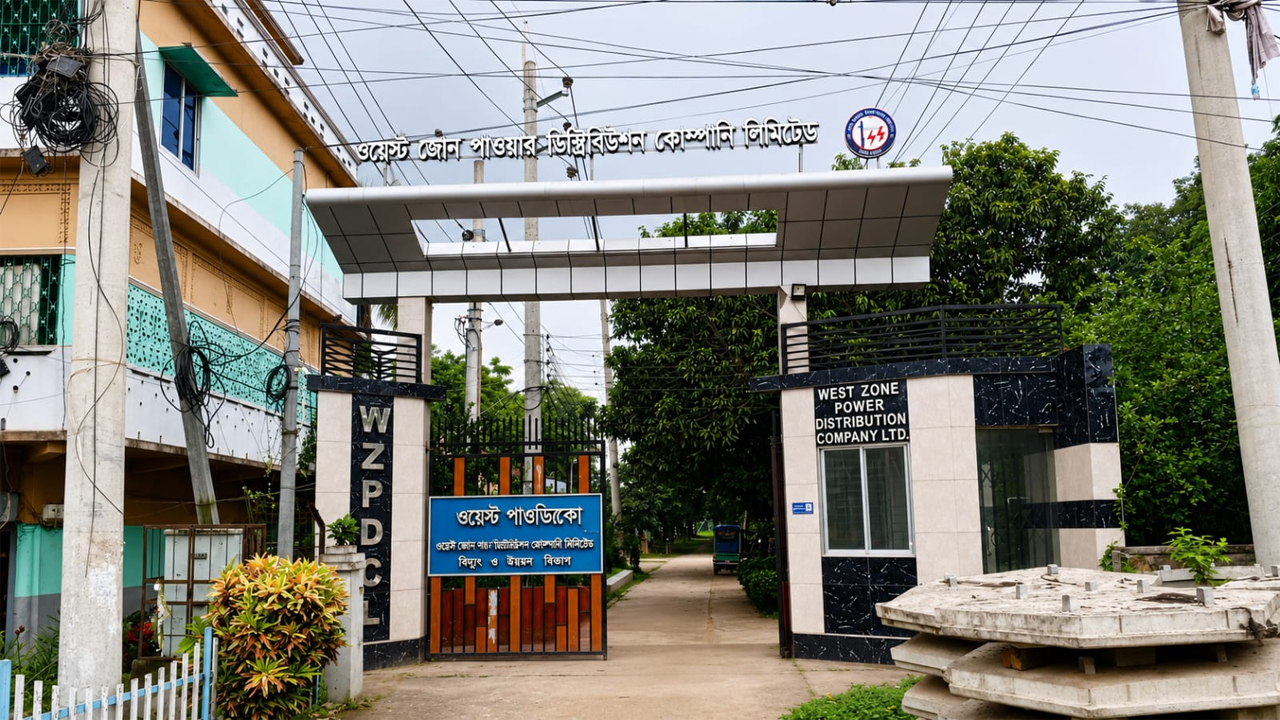
Severe load-shedding is running across Chuadanga, keeping pace with the unbearable, humid heat. Power supply is repeatedly disrupted in town areas, but the picture in the countryside is dire: in areas under the rural electricity board, there is no power for 10 to 12 hours out of the day and night combined. As a result, ordinary people are suffering on one side, while farming, business and small industry have stalled on the other.
Local sources said power is cut three to four times a day in the towns and upazila centres of Chuadanga and Alamdanga, but is restored within about an hour. In rural areas, however, once the power goes there is no sign of it returning for three to four hours. In the intense heat, this has put children and the elderly at health risk.
In this farming-dominated district, it is currently a busy time for keeping irrigation pumps running in the fields. The failure to get power on time is disrupting crop irrigation.
Shahabul Islam, a farmer in the municipal area, said in frustration that the power goes off just after the pump is switched on and it is uncertain when it will return. To save their crops, farmers are being forced to irrigate with diesel-run pumps at extra cost, which is sharply raising production costs.
Low-income working people and local businesses have been badly hit by the power crisis. Battery-run auto-rickshaw drivers, unable to charge their vehicles at night, cannot go out on the roads by day. Rice mills, welding workshops, poultry farms and cold-storage businesses have suffered heavy losses. In several poultry farms, chickens have died for lack of ventilation.
According to sources in the relevant offices, the crisis has arisen because far less power is being supplied from the national grid than is needed. For Chuadanga and Alamdanga together, OZOPADIKO’s roughly 70,000 customers have a demand of 25 megawatts, but only 15 to 18 megawatts is available from the national grid.
Chuadanga OZOPADIKO executive engineer Ahsan Habib confirmed the matter, saying: “Because of this shortfall against demand, we are having to run load-shedding out of helplessness.”
On the other side, the roughly 84,000 customers under the Chuadanga zonal rural electricity cooperative need 20 to 25 megawatts of power a day, but only 10 to 12 megawatts is being supplied. Deputy general manager Mohammad Jasim Uddin said they were being forced to load-shed because they were getting only about half the demand.
Of the power received from the Chuadanga grid sub-station, 30 percent is distributed through OZOPADIKO and 70 percent through the rural electricity cooperative, but neither body can meet demand.
To ensure an uninterrupted power supply to customers and the swift resolution of various problems in the electricity service, the member of parliament for the Chuadanga-2 constituency, Md Ruhul Amin, held an emergency meeting with senior officials of the Meherpur rural electricity cooperative at around 11am on Thursday. The meeting placed particular emphasis on keeping round-the-clock power running at the Jibannagar and Damurhuda upazila health complexes.
“Officials must be more responsible in ensuring service to ordinary people and uninterrupted connections to hospitals and other emergency institutions,” the MP, Md Ruhul Amin, said. The general manager of the Meherpur rural electricity cooperative, Swadesh Kumar Ghosh, and other senior officials were present at the meeting.
বাংলায় মূল প্রতিবেদন পড়ুন · Read the original Bengali report