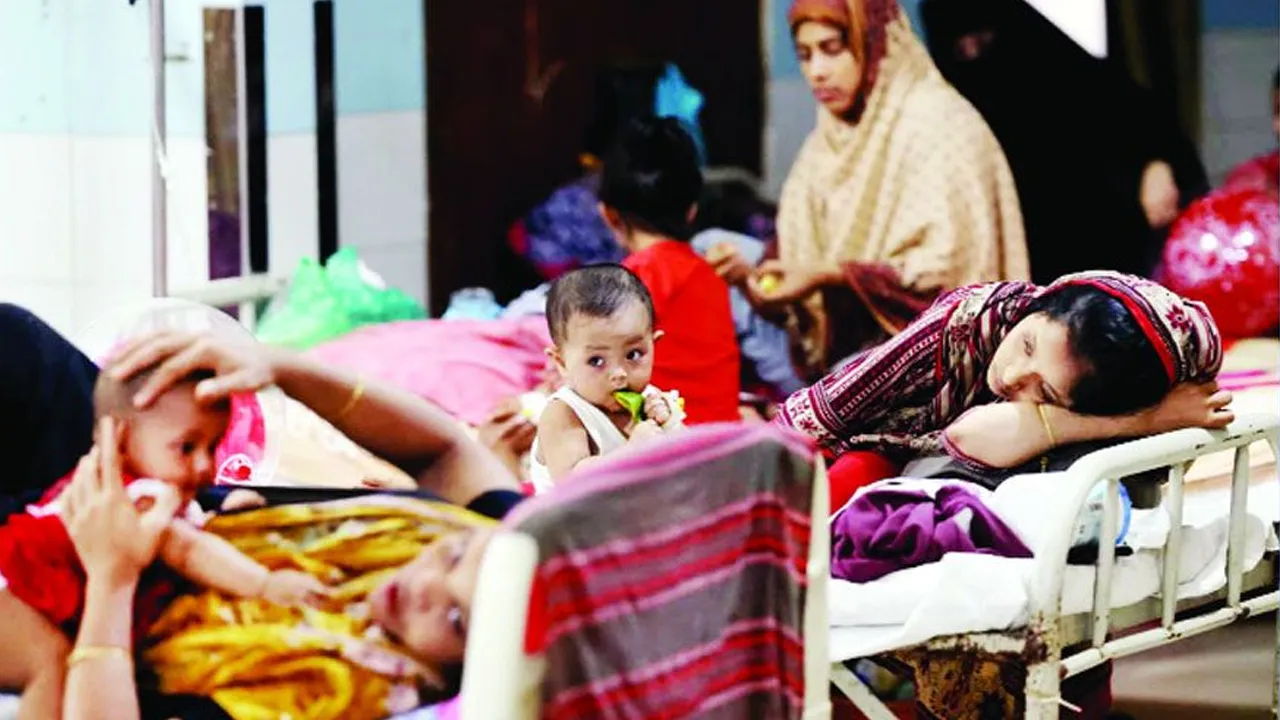
Eighty-two percent of patients admitted to Bangladesh Shishu Hospital and Institute in the capital with measles had not received adequate breast milk from their mothers.
At the same time, a large share of children infected with measles were found to be malnourished, and many had not received adequate breastfeeding during the first six months of life.
These findings emerged from a study conducted jointly by Bangladesh Shishu Hospital and Institute (BASHI) and the International Centre for Diarrhoeal Disease Research, Bangladesh (icddr,b).
The study has examined 354 patients admitted with confirmed or suspected measles from May this year through now.
The study is still ongoing, officials said.
A briefing on the study’s findings was held at 10:00 a.m. Wednesday, August 19, at the auditorium of Bangladesh Shishu Hospital and Institute in the capital’s Sher-e-Bangla Nagar.
State Minister for Health and Family Welfare Dr M A Muhit attended the event as chief guest. Chaired by Professor Dr A K M Azizul Haque, chairman of the Shishu Hospital’s governing board, the event’s special guests included Directorate General of Health Services Director General Professor Dr Provat Chandra Biswas, Director Dr Md Nurul Islam, and IEDCR Director Dr Kazi Ahmed Zaki.
The study’s main paper was presented by Shishu Hospital Director Professor Dr Mirza Mohammad Ziaul Islam and icddr,b Senior Director Dr Mustafizur Rahman.
The study’s main paper found that 43 percent of infected children were between three and nine months old. Thirty-eight percent of measles-infected children had not received exclusive breastfeeding during the first six months after birth. Most alarmingly, 82 percent of children who died while under treatment had not received adequate breast milk.
The study found that 65 percent of infected children were suffering from malnutrition. Of these, 12 percent had severe malnutrition and 53 percent moderate malnutrition.
Researchers analyzed 341 children divided into four groups based on age and vaccination data. Among 146 children not yet old enough for routine vaccination (under 9 months), 97.3 percent (142 children) tested positive for measles. Among 126 children old enough to be vaccinated but who had not received the vaccine, 97 percent (122 children) were found to be infected with measles.
Meanwhile, among 48 children who had received a single vaccine dose, 44 were confirmed to have measles, and among 21 children who had received the recommended two doses, 16 were confirmed infected.
Researchers clarified, however, that this does not mean 76 percent of all children who received both recommended doses are being infected. This rate was observed specifically among the particular group of suspected patients admitted to hospital. They said infection despite vaccination could be linked to various individual factors, including declining antibody levels or malnutrition, and that further, broader investigation is needed on this question.
The study also found that all the viruses present in infected patients belonged to the B3 subclade, similar to B3 viruses found in other countries around the world. Researchers also identified four changes, or mutations, in the epitope region of the virus’s H (hemagglutinin) protein.
বাংলায় মূল প্রতিবেদন পড়ুন · Read the original Bengali report