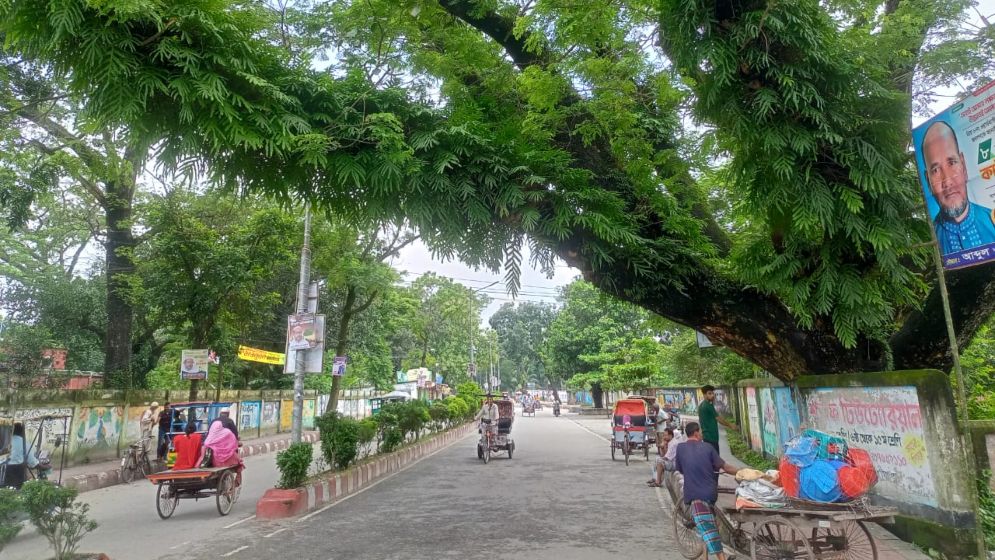
Considering the safety of public life in the town of Saidpur in Nilphamari, a decision has been taken to cut 33 aging, hazardous railway trees. As fear grew among locals over the risk of storms uprooting trees and large branches breaking off, the divisional forest department has given permission to cut these hazardous trees. At the same time, to maintain environmental balance, the railway authorities have planned to plant 5,000 saplings across the town in the monsoon season.
According to railway sources, after the Assam-Bengal Railway’s large workshop was established in Saidpur in 1870, a planned railway town grew up. In the residential areas built for British officers and for workers and staff who came from various parts of the Indian subcontinent, extensive tree planting was carried out alongside roads, drainage and kerosene-lamp streetlights. Many of the numerous rain trees, pakur and other species planted at that time have become hazardous under the weight of age.
A field visit found about 1,000 old trees in the railway colonies of Officers’ Colony, Sahebpara, Mistripara, Munshipara, Hatikhana, Atiar Colony, Golahat, Old Babupara and Bashbari. Of these, 33 have been identified as extremely hazardous. The roots of most have weakened and many are almost dead.
This monsoon season, panic has grown further with one tree after another being uprooted and branches breaking off. In May and July, two huge trees in front of the divisional superintendent’s (DS) residence in Officers’ Colony were uprooted in even light wind. Before that, a rain tree was uprooted at the Panchmatha crossing. On June 30, half of another tree broke off at the GRP crossing. Most recently, on Friday night, a large branch of a century-old pakur tree broke off near Lions School and College on Airport Road. Although these incidents caused no deaths, there are fears of a major accident.
Following the legal process for cutting government trees, the Saidpur Railway’s civil engineering (PWD) department applied to the Rangpur divisional forest officer on May 18. In response, a forest department team inspected the site, and on June 11 permission to cut the 33 hazardous trees was given through a letter signed by divisional forest officer Nurul Islam.
On this, divisional forest officer Nurul Islam said permission to cut the trees had been given to the railway because the hazardous trees could fall at any time and cost lives, and that a directive had also been given to plant new trees to protect the town’s environment and beauty.
The Saidpur Railway’s assistant executive engineer, Tohidul Islam, said the decision to cut the hazardous trees had been taken considering the safety of pedestrians and of those living beneath the trees, and that a decision had also been taken to plant about 5,000 trees to protect the town’s environment and beauty.
বাংলায় মূল প্রতিবেদন পড়ুন · Read the original Bengali report