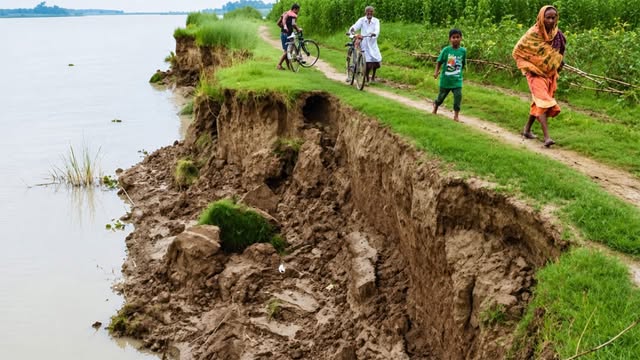
Severe erosion along the Surma River continues to consume homes, farmland, trees, schools and religious sites in Bausa and Keshabpur villages of Chhatak Sadar union in Sunamganj.
The century-old Purba Bausa Central Jame Mosque and Bausa Government Primary School have already disappeared into the river. Residents say more of the bank collapses every day, taking with it people’s homes, memories and prospects.
Residents describe the erosion as the slow death of a community. The Surma becomes particularly destructive during the monsoon, when strong currents and waves collapse the riverbank. Large parts of Bausa and Keshabpur have been lost over the years, while the absence of permanent protection leaves new areas at risk each year.
Older residents said areas now covered by deep water held rice fields, orchards, children’s playing grounds, homes and the village mosque only a few years ago.
Local farmers said they once supported their families comfortably by cultivating their own land. Many have been left with nothing after losing it to the river. Some now work as day laborers or rickshaw drivers, while others have moved to cities for work. Families forced from ancestral homes have sought shelter elsewhere.
The destruction of educational and religious institutions has caused particular concern. Residents mourned the loss of the historic Purba Bausa Central Jame Mosque, while the disappearance of Bausa Government Primary School has severely disrupted children’s education.
A school is more than a building because it shapes a village’s future, residents said. A mosque is not only a place of prayer but a symbol of faith, tradition and social ties. Both have now been lost to the river.
Transport in the area has also been severely disrupted. Sections of riverside road have become dangerous, creating serious difficulty for students, farmers, traders and other residents.
Residents fear the important road could also disappear unless effective measures are taken quickly.
They said they no longer wanted assurances but a permanent solution. Immediate action was needed to protect homes, the mosque, the school and farmland, or Bausa and Keshabpur could remain only names on a map.
Residents said poor management, unplanned intervention and neglect had turned a river that supported crops, boats, fishing and settlement into a source of destruction. Protecting both banks would protect homes, schools, mosques and the community’s future, they said.
The erosion is damaging not only property but also education, the economy, religious life, social stability and residents’ sense of security. Families spend nights in fear as they listen to the riverbank collapse and wonder when their own homes may be lost.
Residents called for an urgently constructed, durable river-protection embankment, a river-management project and rehabilitation for displaced families.
They also urged authorities to adopt a long-term plan to protect schools, religious sites and settlements at risk from erosion.
Chhatak Upazila Nirbahi Officer Mahi Uddin confirmed the erosion and said necessary initiatives would be taken to stop it. The matter had been brought to the attention of the relevant authorities and required steps would follow, he said.
People in Bausa and Keshabpur say they now expect prompt action rather than further assurances. Each monsoon and each new wave brings renewed fear, and without effective intervention the next generation may know the villages only through stories.
বাংলায় মূল প্রতিবেদন পড়ুন · Read the original Bengali report