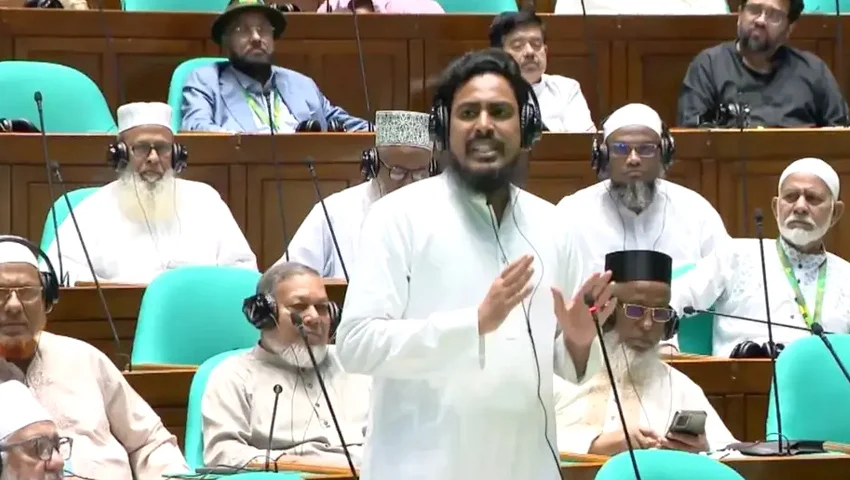
A question has arisen in parliament over the parliamentary areas of reserved women’s seats. NCP MP Akhtar Hossain raised the question, claiming that BNP’s reserved women’s-seat MPs had been given charge of the seats of opposition members of parliament. The opposition MP also asked whether BNP wanted to create a one-party system of governance by giving its women MPs charge of opposition seats. In reply, Home Minister Salahuddin Ahmed said there was no specific territorial constituency for reserved women’s-seat MPs, and that they could carry out their parliamentary duties across the whole of Bangladesh.
Akhtar Hossain raised the issue on a point of order in the Jatiya Sangsad on Monday, with Deputy Speaker Kaisar Kamal presiding. Earlier, during a supplementary question in the question-and-answer session, BNP reserved-seat MP Jeeba Amina Khan said: “Yesterday (Sunday) I visited Pirganj and Mithapukur, which are my additional responsibility.” She said the prime minister had decided to upgrade a 50-bed hospital there to 101 beds, and, raising the hospital’s staff shortage, asked about the government’s initiatives to give the younger generation training so they could work as assistants.
When Akhtar Hossain wanted to speak on that point of order, the deputy speaker did not give him the floor, but he was given the floor after the Asr break. On the point of order, NCP MP for Rangpur-4, Akhtar Hossain, said: “Before the break, the ruling-party reserved-seat MP, while speaking, said it was her additional responsibility. That is, referring to her additional responsibility, she spoke of two parliamentary seats in Rangpur. After she went there, I heard BNP leaders and workers saying things like — ‘The MP elected in this seat is not the MP; the reserved-seat MP is the MP here. Whatever work is to be done must be done through her.'” He said: “That day I heard our state minister Mir Shah Alam say that no additional responsibility had been given to anyone. But the woman MP is saying additional responsibility has been given. Which of these is actually true? What is the scope of this additional responsibility? How will it be carried out? I also want to know how constitutional that additional responsibility is.” He said the additional responsibility had been given only in the seats where opposition MPs had been elected. “This is creating a cause for concern: does BNP want to create a one-party system of governance by giving its women MPs charge of opposition seats? The matter was informal for us, but by raising it in parliament it has now come formally. We want a resolution and an explanation from the government,” he said.
The deputy speaker then gave the floor to Home Minister Salahuddin Ahmed. He said that, under Article 65 of the constitution, the Jatiya Sangsad was made up of 300 general-seat members and an additional 50 reserved women’s-seat members. General-seat members were elected from a single territorial constituency, and these constituencies were redrawn from time to time under the delimitation law on the basis of upazila, municipality, ward or union boundaries. But that territorial limit fixed for general seats did not apply to reserved women’s-seat members, the home minister said. “The limited area of those elected to the reserved seats is the whole country, Bangladesh,” he said. Commenting that reserved women’s-seat members were also full members of parliament like others, the home minister said that the allocations they received as MPs from various ministries and government agencies could be given anywhere in Bangladesh. Naming the reserved-seat MP from his own area, Shamir Ara Begum Swapna, the home minister said a reserved women’s-seat member could, if she wished, make allocations in Cox’s Bazar, or in Banshkhali or Satkania. He said that when a reserved women’s-seat member referred to one or two areas in parliament as “my area,” she was herself limiting her own scope of work. They should say the whole of Bangladesh was their area, he said, and they could carry out their duties as members of parliament anywhere in the country. The idea of responsibility for a specific area, or a specific territorial boundary, did not apply to reserved women’s-seat members, the home minister added.
বাংলায় মূল প্রতিবেদন পড়ুন · Read the original Bengali report