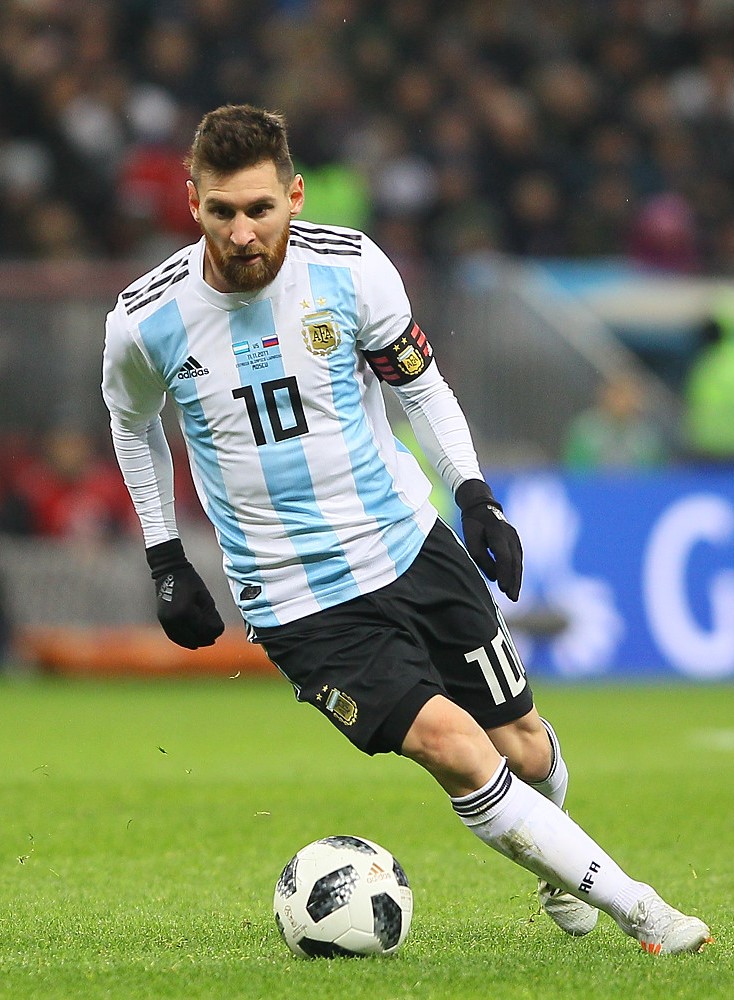
As the late-afternoon sun dipped over the pitch in Dallas, the moment world football had been waiting for arrived. Lionel Messi ran, turned slightly to his left inside the box, and curled the ball into the net with a perfect left-footed finish. Before the roar of the Argentine fans had faded on the air, the record flashed up on the board: the World Cup’s all-time top scorer was now Lionel Messi. Moving past Germany’s legendary Miroslav Klose, he had reached 17 goals, in the 38th minute of the match.
Messi made the story even more colourful in the dying moments, in injury time, when he created a chance almost single-handedly. The goalkeeper rushed out to try to stop him and two defenders took up positions on the line, but Messi, almost lying on the ground, slid in to shoot, and scored. Argentina 2, Austria 0. He took one more shot before the final whistle, which went just wide of the post; otherwise it would have been a hat-trick. At this World Cup, Argentina have now won both their matches, with Messi named man of the match in each, and all five of their goals have come from his feet.
What can you call such a player? Nothing but a magician. With this Messi-dominated win, Argentina secured their ticket to the second round of the World Cup, moving a step further along the road to defending their title.
The story was not so simple, though. Argentina won a penalty early in the match, and Messi stepped up to take it. But the Austria goalkeeper, Alexander Schlager, did not move, watching Messi with calm eyes as if he already knew where the shot would go, and saved it. A penalty miss on the world stage is a heavy weight on any player’s mind, but Messi is Messi, and he did not let the shadow of disappointment linger.
In the 38th minute he built an attack again from midfield. He played the ball to Almada, who carried it forward and pushed it out to Medina on the left; Medina sent it back across to Almada, who, knowing Messi was beside him, dummied a shot and left the ball for the unmarked Messi. Messi then worked his magic with his left foot: the goalkeeper, expecting the ball at the far post, leaned to his right, but Messi placed it at the near post. By the time Schlager turned to his left, it was already too late, and the shot was in the net. Klose had scored 16 goals across four World Cups, a record that had seemed almost impossible to reach, but Messi made the ‘almost impossible’ possible in Dallas. His 17th World Cup goal is not just a number; it is proof of 20 years of sustained excellence.
Austria fought on level terms for spells despite the defeat, with Paul Wanner showing a glimpse of his quality, but their attack clearly lacked depth. Argentina’s midfield lost its way at times but quickly weathered the storm. The one early concern was that, apart from Julian Alvarez, there was no one to run into the space behind, with neither Lautaro Martinez nor Messi making those runs from deep any more. But as long as Messi is on the pitch, there is rarely much need to look for an answer.
At this moment, the whole World Cup seems to revolve around Messi. To watch him is truly a privilege, to see the greatest of footballers break another record and write another story. Those who were in the ground in Dallas will remember this evening for the rest of their lives.
বাংলায় মূল প্রতিবেদন পড়ুন · Read the original Bengali report