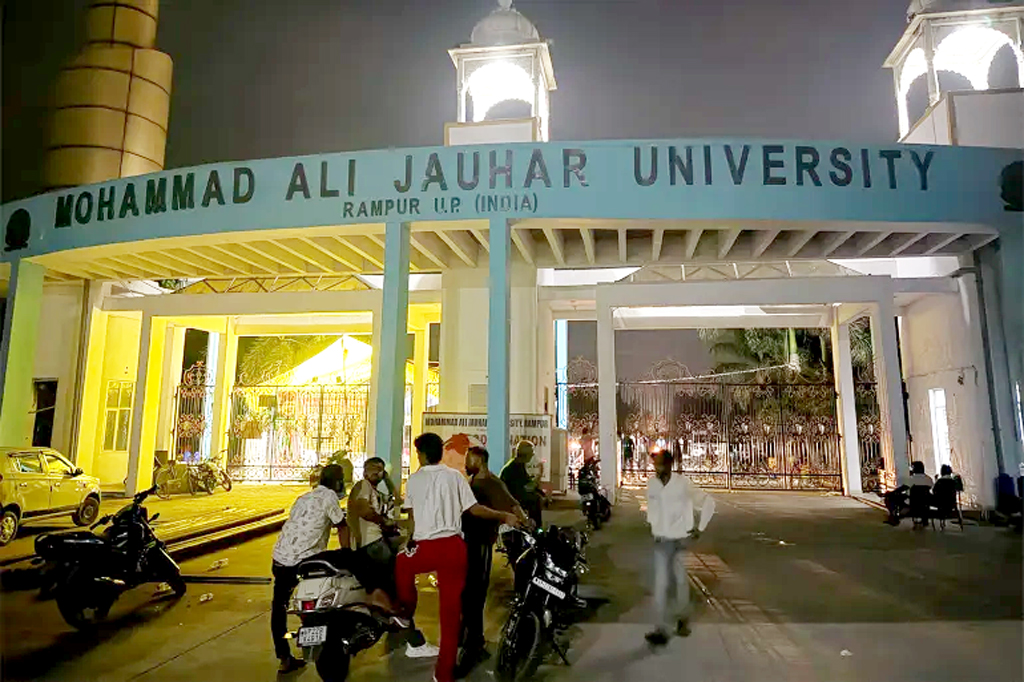
Teachers, students and former students have begun protesting against an administrative order to demolish 38 of the 40 buildings at Mohammad Ali Jauhar University in Rampur, in the Indian state of Uttar Pradesh. Ignoring severe heat, they are holding a sit-in in front of the university’s main gate. The protesters contend that the minority institution has been targeted out of political vindictiveness by the BJP government of Uttar Pradesh’s chief minister, Yogi Adityanath.
The Rampur district administration says the buildings were constructed illegally and in breach of regulatory guidelines. In a notice on 15 July, the Rampur Development Authority (RDA) directed the university authorities to demolish these “illegal” buildings by 5 August. It warned that if the buildings were not demolished within the stipulated time, the administration would carry out the operation itself with bulldozers and recover the cost from the university.
The state administration later issued an interim stay on the order, but the university’s vice-chancellor, Zahiruddin, said the stay does not mean the demolition decision has been withdrawn. “It means that the buildings will not be demolished within the 5 August deadline given by the RDA,” he said. “The university is now seeking a ruling from the court that would set aside or quash this demolition order entirely.”
The university was founded three years after the Mohammad Ali Jauhar Trust was formed in 2003 by the senior Samajwadi Party leader Azam Khan, who is its chancellor for life. The Samajwadi Party member of parliament Javed Ali Khan called the demolition order “the politics of vendetta.” He said: “There are many reasons behind targeting this university. First, it was founded by Azam Khan. Second, its foundation stone was laid by the Samajwadi Party’s founder, Mulayam Singh. Third, it was inaugurated by the state’s former chief minister, Akhilesh Yadav. And fourth, it is a minority university.”
The BJP spokesperson Rakesh Tripathi, contending that the demolition order is consistent with legal process, said: “Can anyone deny that Azam Khan built this university on illegal land? During the Samajwadi Party government he used his position and power to build this university on illegal land and put up illegal buildings. We are only following the law against illegal construction, and that means this university should be demolished.”
Rampur’s district magistrate and the RDA’s vice-chairman, Ajay Kumar Dwivedi, said: “They were given notice and they submitted a written reply as well. Of the 40 buildings constructed at Jauhar University, only two were found acceptable. The remaining 38 buildings have been found to be illegal.”
Rejecting that claim entirely, the vice-chancellor, Zahiruddin, said: “When the university was established, the RDA had no jurisdiction in Singankheda. We are running courses with the approval of various government agencies, which grant approval only when all conditions are met.” Describing the RDA’s move as a violation of the constitutional right to education, he added: “They are using it as a weapon against the visionary Azam Khan, who built this university for the advancement of minorities and of poor and backward people.”
The campus, which extends over 250 acres, currently has 3,000 students, of whom about half are women and more than a third are Hindus.
Iqra, a fifth-year law student, said: “Our parents were satisfied with the atmosphere here and with the security arrangements provided for women students, better than at any other university. If this university is demolished, girls like us will not get a second chance to study anywhere else. Our parents will not agree to send us elsewhere.”
Chandni Diwakar, a first-year Hindu student of paramedical studies, said at the sit-in: “They may call it a university of Muslims, and yes, in terms of legal status it is certainly a minority university, but that does not mean others do not study here. I have been part of this university for the past year and not for a single day have I felt like a non-Muslim at a minority university.”
A former student of the university, Usama Tayyab, recalled other successful protests and asked: “If a union minister can be forced to resign after a protest movement, then why, despite so many students protesting here, can the Uttar Pradesh government not be forced to stop the destruction of the university?”
Usman Ali, a postgraduate law student, said: “If others can get results through peaceful protest, then why as Muslim students can we not win a demand as just as stopping the demolition of our university? If sacrifice is needed for it, we are ready to make it.” He also alleged: “The police are coming to our homes and threatening our parents with consequences, but we will not back down.”
Another former student, Abdul Kalim Ansari, said: “It is astonishing that they are talking about education reform, yet they are silent even though a notice has been issued to demolish a minority university, Jauhar University. The future of all the students and former students here is now at risk, and we do not know where we will go from here.”
Apoorvanand, a teacher at Delhi University, said of the purpose of the demolition: “First, to create a spectacle by setting influential Muslims against their Hindu voters. Second, a sustained campaign is being run against minority institutions throughout this government’s tenure. And third, they do not want harmony between Hindus and Muslims, and universities are one of the biggest centres of that.”
বাংলায় মূল প্রতিবেদন পড়ুন · Read the original Bengali report