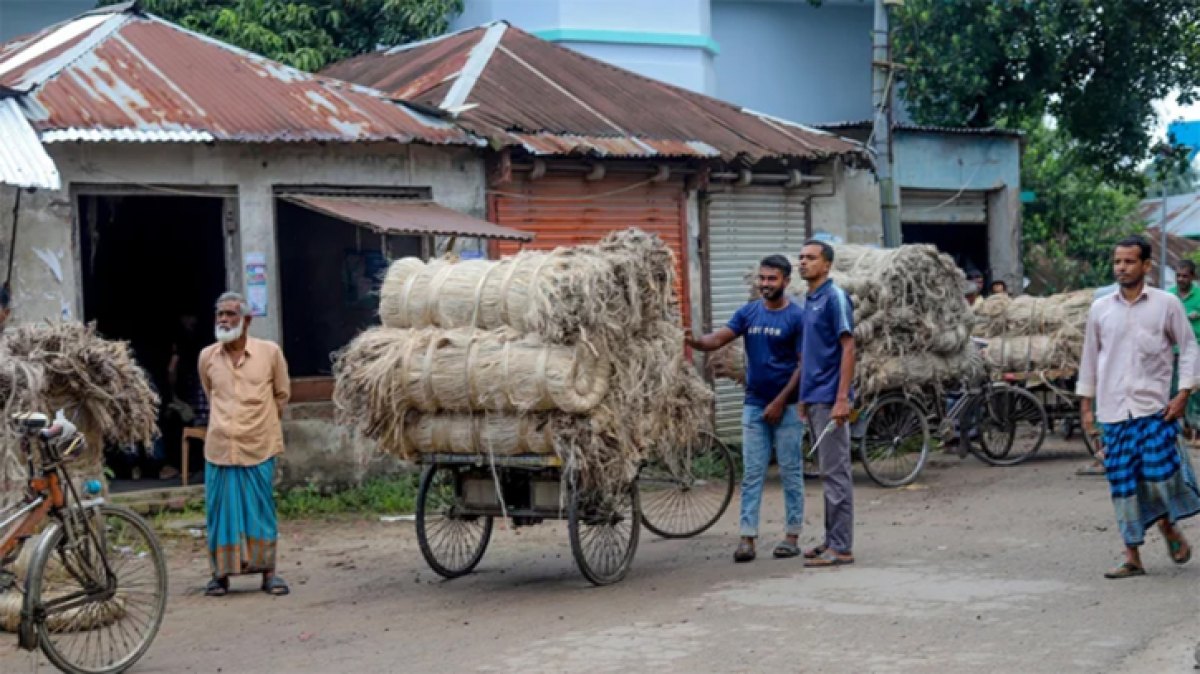
Fields across Narail are busy with jute cutting and retting season. In some areas fiber is being stripped, while in others fresh jute is arriving at the market. This season, jute was cultivated in Narail on more land than the district’s target, and the weather was favorable, leaving farmers hopeful for a good yield. But that hope has faded as prices fell just as the harvest reached the market. According to local traders, jute prices have fallen by 1,000 to 1,500 taka per maund in just two weeks. Medium-quality jute is currently selling for 3,000 to 3,500 taka per maund.
According to the Narail Agriculture Office, the district had set a target of cultivating jute on 23,500 hectares this season. Actual cultivation reached 23,517 hectares — 17 hectares above target.
By upazila, Lohagara saw the most jute cultivation, with 12,165 hectares under jute. Narail sadar had 6,942 hectares and Kaliya 4,410 hectares.
Jute cutting, retting and fiber-stripping are now under way across the district’s fields and wetlands. Trading in new jute has also begun at markets including Naldi Bazar, Shiyarab Hat, Mithapur, Lahuria, Bardia, Maizpara, Lohagara, Kaliya and Tularampur.
Farmers say jute cultivation involves significant expense — land preparation, seed, fertilizer, labor, weeding, cutting, retting and fiber-stripping — and with prices now falling despite a good harvest, they are worried about recovering those costs.
According to information from brokers Sujon and Miraj Fakir at the Erenda hub, jute prices have fallen by 1,000 to 1,500 taka per maund compared with two weeks ago. Medium-quality jute is now selling for 3,000 to 3,500 taka per maund.
Dipak Roy, a farmer from Mulia village, Narail sadar upazila, said: “The jute harvest has been good this year. If prices don’t stay fair, we won’t have any way to survive. We’re appealing to the government to set an official price for jute.”
While fiber prices have fallen, farmers are earning some extra income from selling jute sticks, with trading in jute sticks also under way at various markets across the district.
Farmer Shahidul Islam said traders from Rajshahi, Khulna, Barishal and Bagerhat, among other districts, are coming to Narail to buy jute sticks, which are used in betel-leaf cultivation.
As a result, jute sticks have become an additional source of income for farmers alongside fiber. However, with prices for fiber — jute’s main product — falling, farmers’ overall expected income is at risk of coming in lower than hoped.
Arifur Rahman, deputy director of the Narail District Department of Agricultural Extension, said: “Favorable weather this year, along with the timely supply of quality seed, fertilizer and technical advice from the agriculture department, has led to good jute cultivation and yields in the district.”
He said farmers are being given regular advice on improving jute quality.
বাংলায় মূল প্রতিবেদন পড়ুন · Read the original Bengali report