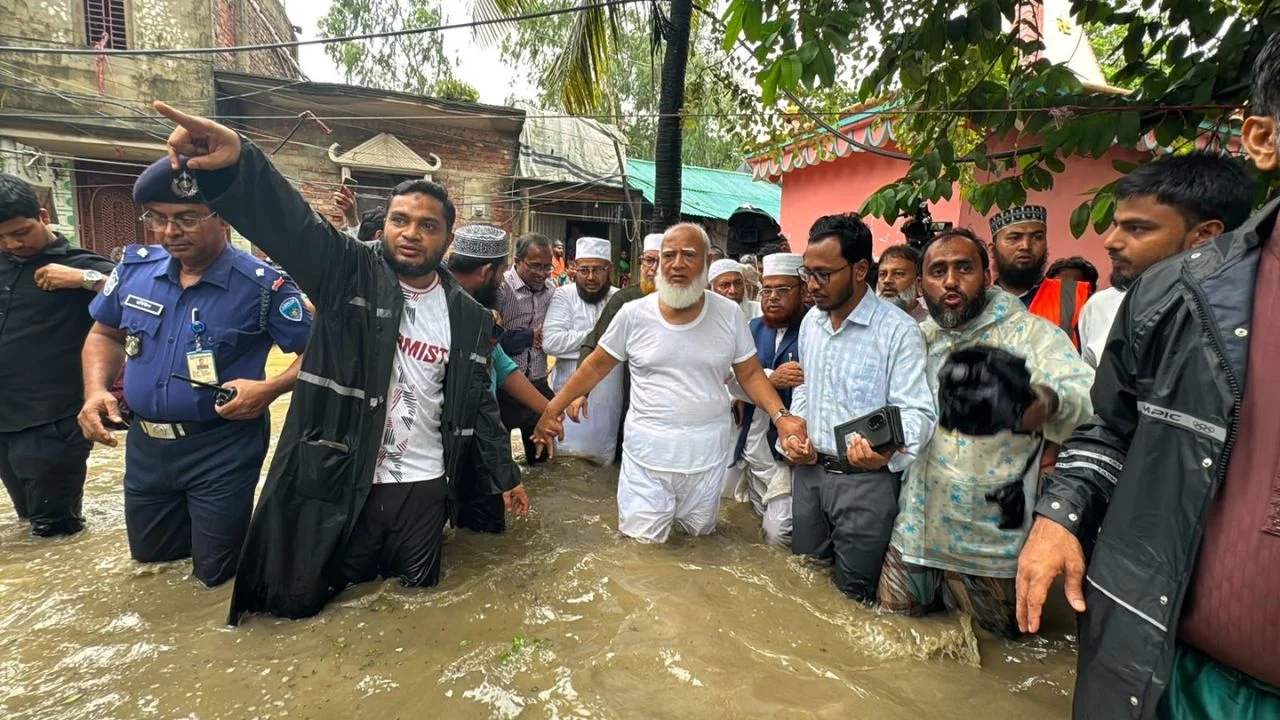
As he entered Ward No 2 of the Gunagari area of Banshkhali, a single call suddenly spread all around. Some waved from the verandas of their homes, some from temporary shelters, and some while standing in waist-deep water, passing word to others. A few children ran ahead, and the elderly gathered by the roadside.
‘Dadu’ — with this one word, everyone recognises Bangladesh Jamaat-e-Islami Amir and Leader of the Opposition in the National Parliament, Dr Shafiqur Rahman. The nickname, meaning grandfather, spread on social media before the election and is now on many lips. During his visit to flood-hit Banshkhali on Friday, the call took on real, visible form.
Dr Shafiqur Rahman got out of his car and began speaking with local people, then went to a temporary shelter beside Labu’s shop. There he handed cash and relief supplies to more than a hundred families who had been trapped by the water for three days.
He did not stop once the relief had been distributed. He went himself to see the houses where water had entered and people could not get out. Rolling up the lower part of his panjabi, he waded through waist-deep water to reach one house after another. At some doorways he stopped to ask after people; elsewhere he spoke with the children and the elderly inside. To some he handed help; on others’ shoulders he laid a hand to give courage.
Ahmed Hossain, a resident of Gunagari, said: ‘For three days we have been in the water. Many people came, took photographs and left. But he came right up to our house to check on us.’
Farasha Begum, sheltering on the second floor of Labu’s shop, said: ‘The water reached the roof of our house. We got out with our lives alone. He came and listened to us and gave us help. It makes you feel that at least someone is thinking of us.’
Rubel Hossain, a local youth, said: ‘People call him Dadu. Today I saw that, hearing the call, he went straight to the people. He did not just stand in a safe spot, hand out relief and go back.’
Kiran Bala Jaldas, staying at the same shelter, said: ‘I have a small grandchild with me, and also a 20-day-old baby. He came and asked after the children. When someone stands beside you at a time like this, you find courage.’
According to local residents, at least 300 houses in Gunagari are under water. Many families have been forced to leave their homes for three days, taking shelter in schools, on the upper floors of shops, or at relatives’ houses. The children, the elderly and the sick are suffering the most.
After distributing relief, Dr Shafiqur Rahman spoke to journalists.
‘I have not come here to do politics,’ he said. ‘I have come to stand by people in distress. I came to see Chittagong’s flood situation with my own eyes and to hear from those who have been affected.’
He said the Chittagong flood situation had been discussed in the National Parliament on Thursday, with the opposition raising the matter and the government also making a statement under Rule 300.
‘People’s suffering cannot be understood on paper,’ Dr Shafiqur Rahman said. ‘Without coming to the field, it is impossible to feel this pain. The government should quickly arrange rescue, rehabilitation and the necessary support for affected people.’
Remembering those killed in the recent floods, landslides and other disasters, he said: ‘I offer my deep condolences to those who have lost their lives. May Almighty Allah grant them forgiveness.’
After finishing his remarks, he again moved towards the people standing in the water. Some wanted to shake his hand, some to take a photograph, and some simply to tell him of their losses.
From behind, the same call still drifted through the air: ‘Dadu is coming… Dadu is coming…’
বাংলায় মূল প্রতিবেদন পড়ুন · Read the original Bengali report