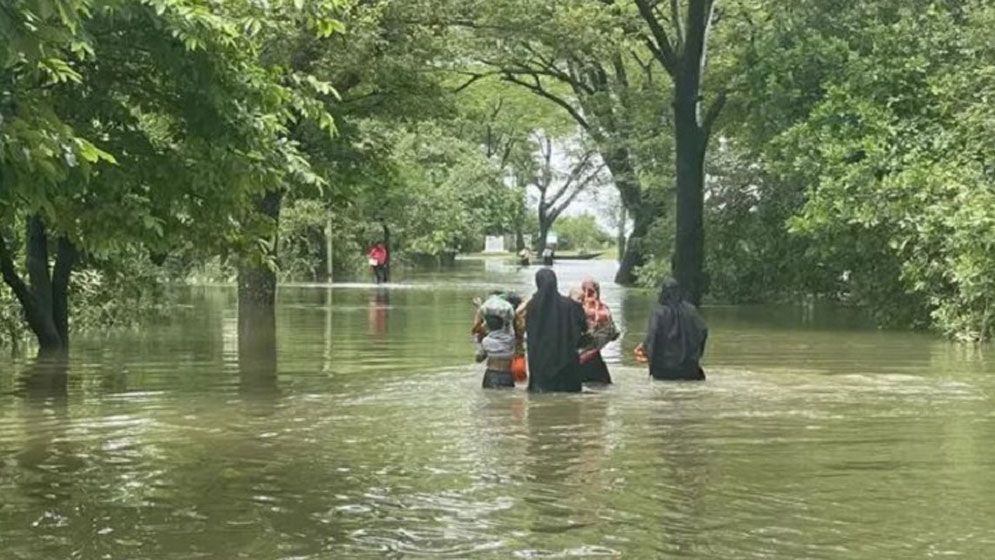
Floods are among Bangladesh’s most common natural disasters, and heavy rain has left several parts of the country inundated this year, marooning thousands of families and depriving flood victims of safe food, clean drinking water and a minimum standard of shelter. Floods also bring a number of diseases, and everyone must stay alert to them while coping with the disaster.
Safe drinking water: Water sources during floods must be boiled well and cooled before drinking, and treated for other household uses too. If a tube well is submerged, mix three or four teaspoons of bleaching powder in a pitcher of water and pour it into the tube well; leave it for half an hour, then pump continuously for another half hour and discard that water, after which the water becomes usable. If bleaching powder is unavailable, pump the tube-well water continuously for an hour. For safety, tube-well water should still be boiled – kept at a rolling boil for 30 minutes and then cooled. Where boiling is not possible, water can be purified by adding a 7.5-milligram halogen tablet (Halo Tab) to every 1.5 liters of drinking water, a 15-milligram tablet to three liters or a 50-milligram tablet to 10 liters, and leaving it for half an hour to an hour. Adding 250 grams of bleaching powder to every 1,000 liters of water in a household tank and leaving it for an hour will also purify the water – though this does not destroy viruses.
Preventing diarrhea: The main health problem during floods is diarrhea, so hands must be washed thoroughly before eating and after using the toilet. If diarrhea begins, oral rehydration solution (saline) should be taken as needed – 10 to 12 teaspoons after each loose stool for a child under two, and 20 to 40 teaspoons for a child aged two to 10. If oral saline is unavailable, a salt-and-molasses drink can be given as an alternative, along with rice starch, flattened-rice water or coconut water, or, if nothing else is available, just safe water. Khichuri can be fed to prevent malnutrition in children during this time, and a vitamin A capsule may also be given. If loose stools and vomiting increase, the patient must be taken to the nearest health center.
Care with food: During floods, countless people are forced to eat stale or spoiled food, spreading diarrhea and other diseases. Khichuri is a healthy option at such times. Plates must be washed with soap and safe water. To save water, some first wash their dishes in ordinary water and then rinse them in boiled water, but this is wrong, as it spreads many germs onto the dishes.
Guarding against accidents: Sudden accidents are common during floods, most often from electricity, drowning, and snake or insect bites. If an electrical wire is seen snapped or lying in water, it must not be touched, and power workers must be informed urgently. Snakes and rats, having lost their habitats, take shelter with people and livestock on dry ground, increasing the number of snake and rat bites. A bite from a non-venomous snake is not dangerous, but if a venomous snake bites, a thick cloth, gamcha or rope should be tied above the bite and the person taken quickly to hospital, where anti-venom and a tetanus vaccine should be given urgently. A rat bite should not be neglected either, and a doctor should be consulted.
Care with defecation: During floods, one should not defecate just anywhere, as this increases stomach ailments and worm infections. Where possible, a specific place should be used, and hands washed well with soap or ash afterward. Going barefoot while defecating can allow hookworm to infect the body, so everyone in the household should take deworming medicine at this time – though for children under two, a doctor should be consulted.
Post-flood care: After a flood, people (except children under two) and livestock should be given deworming medicine. Snails act as intermediate hosts for various parasites and worms of humans and animals; these snails can be used as duck feed or should be destroyed. Deworming medicine should also be taken regularly, every four to six months.
বাংলায় মূল প্রতিবেদন পড়ুন · Read the original Bengali report