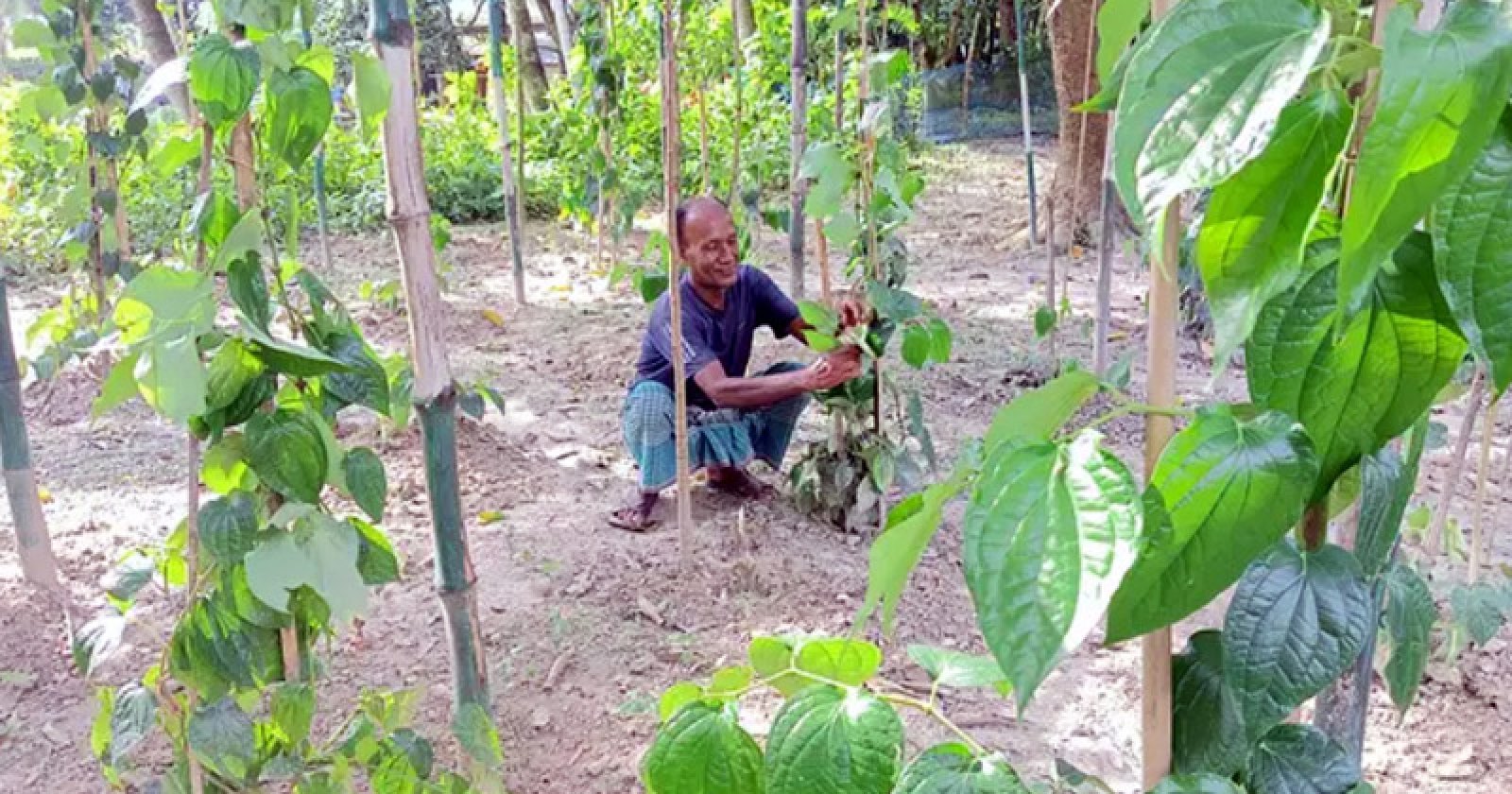
Chui jhal, a pungent spice root once known mainly as a traditional cooking ingredient in Bangladesh’s southwest, is now making its way into farmers’ fields in Rajshahi. Having moved past the experimental stage, commercial cultivation of the crop has now begun in Rajshahi and Natore. With good prices, no need for additional land, and a cultivation method similar to betel leaf, the agriculture department is optimistic about the crop’s prospects.
Farmer Abdur Rashid Molla is already growing chui jhal commercially in Chandopara, Jahanabad union, Mohanpur upazila, Rajshahi. He has planted the vine on about 10 decimals of land beside his house, under mango trees, where the plants are growing vigorously and appear healthy.
“I took up chui jhal cultivation with support from the Mohanpur agriculture office and the Rajshahi Horticulture Center,” Abdur Rashid Molla said. “Having experience growing betel leaf, I found looking after chui jhal relatively easy. So far, the plants haven’t shown any disease. I’m planning to produce saplings locally and share them with other farmers in the village as well.”
He added: “Chui jhal has commercial potential, and it fetches a good price in the market. We don’t yet have a large market in our area, but the Horticulture Center has shown interest in buying chui jhal at market rates.”
Agriculture department officials say Mohanpur was chosen for chui jhal cultivation because betel leaf already grows well there, and the cultivation method for chui jhal is similar. Experimental cultivation began there in late 2024. After roughly two years of satisfactory yields and plant growth, an effort is now underway to expand cultivation.
Chui jhal is a flowering, vine-like plant. Its stem, roots and branches are used as a cooking spice, particularly in beef, mutton, duck and chicken dishes, where its use is growing increasingly popular. Adding it to a dish gives food a pungent taste and a distinctive aroma.
Chui jhal has long been a traditional spice in the southwestern districts of Khulna, Jashore, Satkhira and Bagerhat, and demand for it is rising in the wider market. Depending on quality, dried chui jhal sells for between 1,800 and 3,000 taka per kilogram. There is a market for it both fresh and dried. Meat cooked with chui jhal has become a particular draw at restaurants across the country, including in the capital, Dhaka.
Local resident Saiful Islam said: “I wasn’t very familiar with chui jhal before. When I learned it was being grown locally, I looked into its popularity on social media. Now that it’s being grown in our area, we’ll try it in our meat dishes too.”
There is also growing potential in sapling production. Shamim Iqbal, deputy director of the Natore Horticulture Center, said that after good results from chui jhal cultivation there, production has been scaled up. Each chui jhal cutting sapling currently sells for 25 taka. However, he said, chui jhal cultivation requires relatively elevated land.
Sayeda Dil Salin, a horticulturist at the Rajshahi Horticulture Center, said: “After we introduced chui jhal on an experimental basis in Mohanpur, we saw good yields and growth. It’s also being grown in Natore. Because the cultivation methods for betel leaf and chui jhal are similar, Mohanpur was considered suitable for expanding cultivation.”
বাংলায় মূল প্রতিবেদন পড়ুন · Read the original Bengali report