The July 2024 mass uprising was the most glorious and spontaneous popular revolt in Bangladesh’s history. From the capital, Dhaka, to rural settlements it brought people of every level and every faith into a single line behind the demand for the fall of the autocrat Hasina. In this fight of people at every level, women’s forceful participation was undeniable. Their fearless involvement turned the course of the movement. Women’s contribution to the July revolution was many-sided. From the beginning they took an active part in the movement, led it, and helped drive it forward in many ways, including shielding their brother-comrades in the movement. The autocrat’s “shoot on sight” policy was so merciless that, just as it sought to silence the young women fighting in the streets, it also took the lives of innocent children and of mothers and sisters standing on the safe balconies or roofs of their homes.
In a report published by the Ministry of Women and Children Affairs in December 2024, we learn the identities of 10 women martyrs. They are: Maya Islam (60), Shahinur Begum (55), Nasima Akter (24), Meherun Nesa (22), Liza Akter (21), Sumaiya Akter (20), Naima Sultana (19), Nafisa Hossain Marwa (17), Rita Akter (17) and Riya Gope (6). From among them, we try today to set out the heroic stories and unforgettable contribution of two women martyrs.
Naima Sultana
July’s first woman martyr was the 16-year-old Naima Sultana. She was a tenth-grade student in the science section of Milestone School. Naima’s family lived in a rented flat in sector 7 of Uttara. Her father was a village doctor who travelled between their village home and Dhaka. It was only for Naima’s education that her mother stayed in Dhaka with the children.
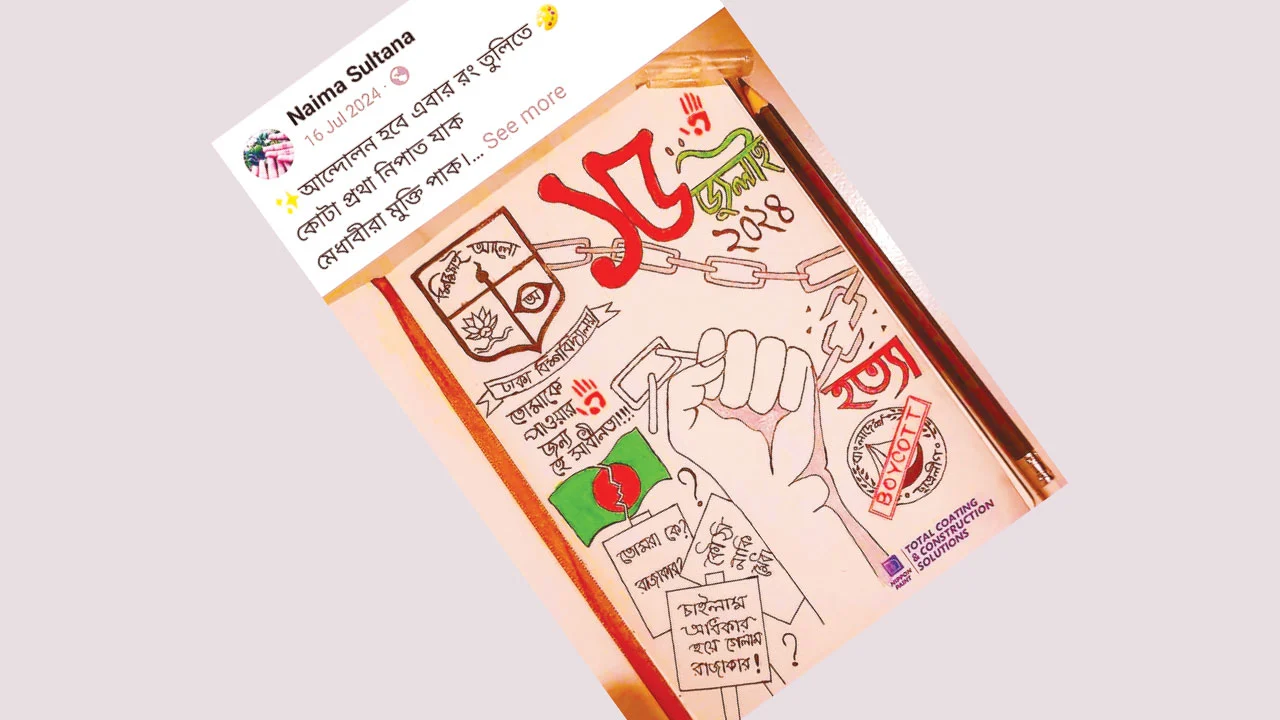
Naima spent her free time drawing. At the start of the quota-reform movement she passed her time at home drawing protest pictures in her notebook with various slogans. On the day before she died, 18 July 2024, about 30 students and members of the public were killed by police fire in Uttara. That night Naima was drawing posters for the movement and chatting with her mother. At one point she said to her: “Mum, suppose I go to the movement and die — what will you tell people?” Without giving her mother a chance to answer, she spoke again herself: “You will say she has become a martyr. My daughter has become a martyr.”
Friday, 19 July 2024. A little way from their house, in front of Uttara Adhunik Medical, clashes broke out between students and the public on one side and police and their allies from the Chhatra League and Jubo League on the other. At one point armed Chhatra League leaders and workers and some police entered the surrounding lanes and began firing indiscriminately. At about 4 p.m. Naima was sitting in her room drawing protest posters in coloured ink with slogans such as “Boycott Chhatra League” and “We want quota reform.” A little later, hearing shouting in front of the house, she ran out to the balcony. Police were firing at protesters below her home. As she turned on the video camera of the phone in her hand and pointed it downwards, police fired at her. Naima collapsed on the floor in an instant.
The bullet passed through her head. Naima cried out “Mother” as she was hit. Her mother and elder sister, in the room behind, ran to the balcony at her cry and found Naima collapsed on the floor, bleeding from the head, her blood spread across the balcony. Seeing her daughter in this state, her mother fainted. At the sound of her sister’s crying, residents of the surrounding flats and students below came and carried Naima to Uttara Adhunik Medical. But she had already left the world.
That same night Naima’s body was taken to their village home in Amuakanda village of Matlab North upazila in Chandpur. On the way the family faced various forms of police harassment. They had to face question after question: where the body had come from, how the death had happened, where it was being taken. After the funeral prayer at 9:30 the next morning, Naima was buried in the family graveyard. Naima, a bright student of Milestone, was very good at her studies. She had the habit of writing a diary every day. Her diary also records how her elder sister surprised her every year on her birthday. Had she lived, she would have turned 17 on 25 July this year. Naima came into the world in her mother’s arms in July, and it was in that same July that she was lost. Every year when July comes, her family’s unbearable pain grows sharper.
Rita Akter
Rita Akter was just 17. Her dream was to become a doctor and end the poverty and hardship of her poor parents. But she had to take her leave of the world before that dream could be realised. Rita’s home was in Talkhur village of Punot union in Kalai upazila, Joypurhat. Her father, Ashraf Ali, is a rickshaw puller and her mother, Rehena Bibi, a homemaker. Of three siblings, Rita was the middle one. Her elder brother did not study much and works as a day labourer. Her younger brother has only finished primary school. Being good at her studies, Rita was the family’s one hope.
When her parents wanted to marry off the indomitable Rita while she was in the eighth grade, she told them clearly that she did not want to marry. She wanted to grow up and become a doctor, to earn and feed her parents, to take charge of the family. So her parents did everything within their means to give their daughter the chance to study properly. Her mother, Rehena, met the cost of her daughter’s education from what she earned working in people’s houses.
After passing Dakhil from the village madrasah, her father came to Dhaka with the whole family so that she could study at a city institution for higher secondary. He enrolled his daughter in the science section of Mirpur Duaripara Government College. For her convenience he rented a small, cheap house in Mirpur-2, H block, right next to the college. Her father pulled a rickshaw in the Mirpur area, and her mother worked in people’s houses.
On the morning of 5 August her parents went out to their work. Taking that opportunity, Rita left home at about 11 a.m. to join the “March to Dhaka” programme. When her mother returned home at midday she found her daughter gone. She went out to search. Even after searching a great deal in the surrounding area she could not find her anywhere. Getting no news of her daughter until evening, they began searching the morgues of various medical colleges.
Running from one medical college to another, after 10 p.m. they found their daughter’s body in the morgue of Sohrawardy Medical College Hospital. They identified her by the clothes she was wearing. From the people who had brought the wounded Rita to the hospital, the family learned that a bullet had passed through her head. After she was brought to Sohrawardy Medical, immediate treatment was not available; treatment was delayed. By the time doctors began treating Rita, she was no longer alive. The next day her parents took their daughter’s body to their village home. Rita was buried in the village graveyard.
From childhood Rita was active in co-curricular activities alongside her studies. She took part in various competitions in Islamic songs, hamd and naat, and came first several times. Her teachers too had dreamed that Rita would one day rise high, and that this bright student would make an important contribution to building an ideal society. But another flower has fallen before its time.
বাংলায় মূল প্রতিবেদন পড়ুন · Read the original Bengali report