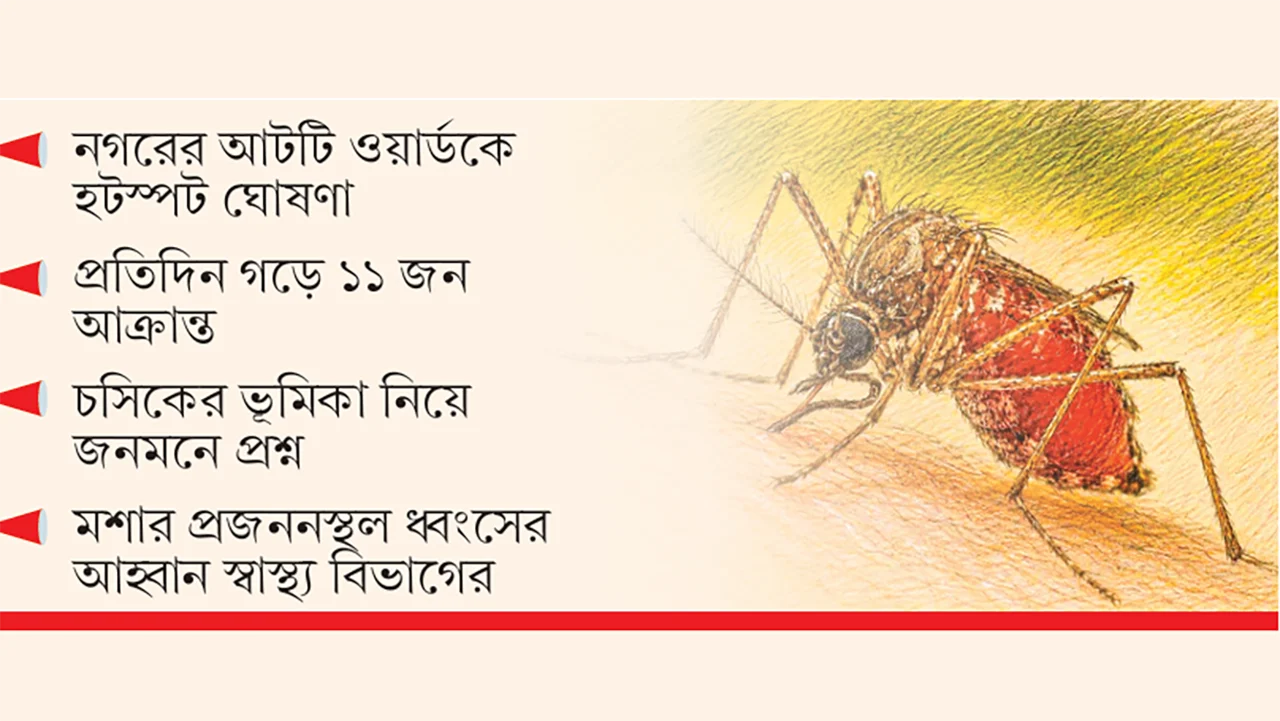
The number of dengue patients is rising alarmingly in Chattogram, with an average of 11 new infections reported daily. While cases were concentrated in the city earlier in the year, infections have increased in rural areas since the start of the monsoon season. Fifty-seven people were infected with dengue in the first five days of this month alone, including 18 cases in a single 24-hour period last Sunday. The office of the Divisional Health Director has designated eight city wards as high-risk dengue hotspots. A recent survey found Aedes mosquito larvae in one of every four households in these areas. The sharp rise in infections has caused public concern and raised questions among residents about government hospitals’ preparedness and the role of Chattogram City Corporation. Residents allege that dengue-control spraying is not being carried out regularly across the city’s 41 wards, and that spraying frequency has not kept pace with the growing mosquito menace, with some areas going a month without spraying or fogger machines.
The district civil surgeon’s office and City Corporation officials say separate dengue corners have been set up at every government hospital, with more test kits and beds added, and priority treatment being provided to patients. They are also urging residents in each area to help destroy mosquito breeding sites.
Chattogram City Corporation says adequate spraying is being carried out across all areas, along with an increase in personnel and the use of higher-quality insecticide, though some residents hold misconceptions since spraying must be timed carefully.
According to the district civil surgeon’s office, nine people were infected on the first day of July, followed by 10 the next day, seven on July 3, 13 on July 4, and 18 on July 5. From January through July 2 this year, 355 people have been hospitalized with dengue — 131 in the metropolitan area and 144 in the wider district, with the remaining 80 from other districts.
By month, infections this year totaled 68 in January, 22 in February, 20 in March, 29 in April, 37 in May, 122 in June, and 57 in the first five days of July — nearly triple the monthly average compared with earlier months, with roughly 11 new cases a day.
The district civil surgeon’s office said 51 patients are currently receiving treatment at hospitals across the city, with the largest number — 28 — at Chattogram Medical College Hospital. At the upazila level, Sitakunda has recorded the most cases with 35, followed by Raozan with 17 and Mirsharai with 15.
Of those infected in Chattogram this year, 197 are men, 93 are women, and 65 are children. One death has been recorded in the city over the past five months. Rural areas have seen more cases than the city over the past three months.
Last year, Chattogram recorded 4,864 dengue cases and 27 deaths. The city’s highest death toll came in 2023, when 107 people died among 14,087 recorded cases.
The office of the Divisional Health Director has declared eight city wards high-risk following a survey on the Aedes mosquito, the vector for dengue and chikungunya, which found the mosquito present in every surveyed ward. Ward 10 (North Katalganj), Ward 3 (Pahartali), Ward 2 (Alkaran), Ward 17 (West Bakalia), Ward 19 (South Bakalia), Ward 39 (South Baluchara), Ward 34 (Patharghata) and Ward 32 (Andarkilla) were identified as the highest-risk areas.
According to the Divisional Health Director’s office, the survey covered 370 households across 18 of the city’s 41 wards. Aedes larvae were found in 99 households — 26.76%, or roughly one in four — and 114 larvae-positive containers were identified during the survey.
The report noted that 70 to 80% of the Aedes mosquitoes identified were Aedes aegypti, the primary vector for dengue, with the remaining 20 to 30% being Aedes albopictus, the secondary vector.
Chattogram City Corporation’s chief conservancy officer, Commander Ikhtiar Uddin Chowdhury, said spraying is carried out daily across seven zones, with personnel increased from 160 to 200 and all old and defunct fogger machines repaired and put back into service. “We are working to destroy mosquito breeding sites. We will act quickly on any complaint,” he said. Divisional Health Director Dr. Sheikh Fazle Rabbi said three courses of action have been set: the findings have been shared with the City Corporation for follow-up, effective and quality insecticide application has been requested, and service personnel are being trained. “We have arranged sufficient kits, mosquito nets and dengue corners at hospitals. We want treatment for any patient to be available at the upazila level. We appeal to the public to destroy Aedes mosquito breeding sites in their own homes,” he said.
বাংলায় মূল প্রতিবেদন পড়ুন · Read the original Bengali report