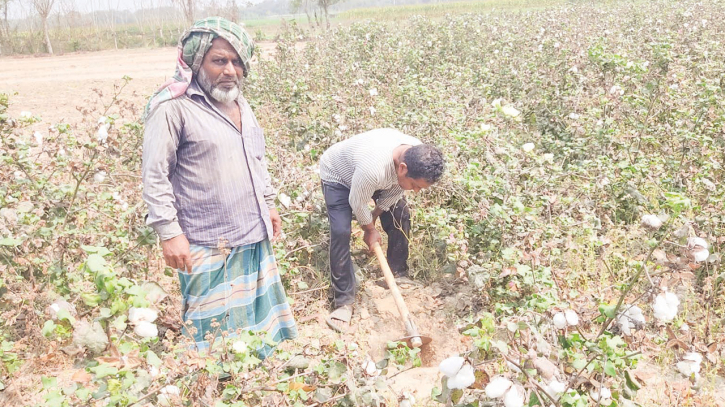
Cotton is one of the main raw materials of Bangladesh’s garment industry. As output falls short of demand, large volumes must be imported each year, costing crores of taka in foreign currency. To cut this import dependence, the government has taken steps to expand cotton cultivation, raise output and make farmers economically self-reliant through incentives.
But serious irregularities have been alleged at the field level. Cotton farmers in the Jashore region say their preferences and experience are being ignored and they are being forced to take a particular company’s seeds, raising fears of a poor harvest this season.
Under the Bangladesh Cotton Development Board’s Jashore zone, there are 16 cotton-production units, including Manirampur, Jhapa, Jashore Sadar, Khajura, Jhikargacha-1 and 2, Keshabpur, Sharsha, Ulashi, Chougachha, Hakimpur, Porapara, Chuknagar, Barobazar and Kaliganj. About 3,000 incentive-receiving farmers will grow cotton under these units this year.
Farmers allege that although they asked for Supreme Seed Company’s “White Gold-1” and “White Gold-2” varieties, they are being handed Ispahani’s “Lal Teer” and “BM-4” brand seeds. Several said they did not get the expected yield from Lal Teer seeds a few years ago, whereas this season White Gold seeds produced 10 to 12 maunds of seed cotton per bigha.
Several cotton growers in Chougachha and Jhikargacha said they were reluctant to take Lal Teer seeds because of poor germination and questions over yield, but many were afraid to protest openly for fear of being dropped from the incentive list. Farmers alleged that the Jashore zone’s chief cotton development officer, Mizanur Rahman, was pressuring field-level unit officers to distribute a specific company’s seeds.
Mizanur Rahman denied the allegation. Asad Hossain, the officer in charge of Jhikargacha Unit-1, said Lal Teer seeds had been supplied as per farmers’ demand, and that while 450 farmers grew cotton in his unit last year, the number could exceed 600 this year. Abu Saeed, officer of the Chougachha and Hakimpur units, said that against a demand of 350 kg of seed for 530 farmers, he had so far received 143 kg of Lal Teer’s China hybrid seed. Asked whether seed was being distributed despite farmers’ reluctance, he said: “We distribute among farmers whatever we are allocated.”
This year, 3,000 farmers in the Jashore region will grow cotton on about 3,000 bighas, with a target of 35,000 to 40,000 maunds of seed cotton at an average 12 to 15 maunds per bigha. At about 4,000 taka a maund, a farmer can earn 55,000 to 60,000 taka per bigha. Under the incentive, each farmer receives 600 grams of cotton seed, fertilizer and pesticide worth about 8,000 taka.
Farmers alleged that 60 kg of the disputed seed had already been distributed in the Kaliganj and Barobazar units, with the same being prepared for other units, and feared that low-quality seed would cut output, hurt farmers and undermine the government’s target of raising cotton production.
Older local farmers said cotton cultivation in the Jashore region saw a boom around 1976-77, but the promising sector was nearly destroyed by irregularities, corruption, mismanagement and policy weakness. Interest has revived over the past few years, and those concerned fear that, if the low-quality-seed allegations prove true, the sector could face another major crisis.
Repeated attempts to reach the Cotton Development Board’s Jashore zone deputy director, Mozaddel Al Shamim, for comment were unsuccessful. Mizanur Rahman, denying the allegations, said: “The government gives farmers incentive seeds free of cost. Neither Lal Teer nor Supreme — no company’s seed is bad. All seeds are of good quality and yield well. Seed imports are decided on the basis of government gazettes, demand letters and resolutions. If a company cannot supply on time, alternatives must be arranged. We always prioritize farmers’ interests.”
বাংলায় মূল প্রতিবেদন পড়ুন · Read the original Bengali report