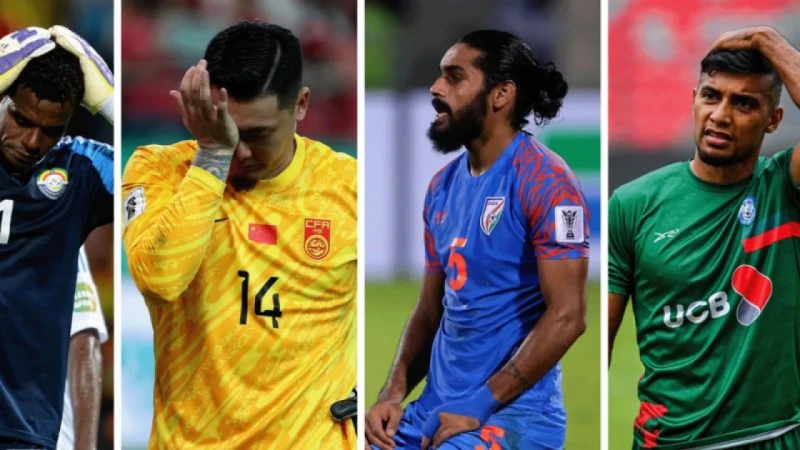
Whenever the World Cup arrives, a festive football atmosphere spreads across the streets of Bangladesh, India, Pakistan and Indonesia. In various parts of Dhaka, thousands gather around big screens to watch Argentina play, celebrating Messi’s goals as if it were an inseparable part of the World Cup itself. Yet none of these countries’ own teams are part of that celebration. The question arises: despite having hundreds of millions of football-loving fans, why can’t these countries secure a place at the World Cup?
A BBC analysis found that it isn’t just population — economic capacity, infrastructure, long-term planning and the sustained development of football culture all play a crucial role in a country’s World Cup success.
Celebration in Dhaka over Messi’s goal, but Bangladesh nowhere on the pitch
After Lionel Messi scored in Argentina’s match against Algeria on June 17, thousands of fans erupted in celebration at various open venues across Dhaka. Many wore Argentina’s sky-blue-and-white jersey. But not one of those spectators was an Argentine citizen — they were all Bangladeshi football fans.
Similar scenes have been observed in various cities in India and Indonesia. With their own teams absent from the World Cup, many fans instead support Argentina, Brazil or other popular teams.
A large population alone doesn’t bring success
Theoretically, the larger a country’s population, the greater the likelihood of finding talented players. Most World Cup-winning countries are indeed populous — Brazil, Argentina, France, Germany, England, Italy and Spain are examples.
But Uruguay is an exception. A country of just 3.5 million people has won the World Cup twice.
According to British economist and “Soccernomics” co-author Stefan Szymanski, population matters, but it is not the only condition.
In his words: “To succeed in football, a country needs money and infrastructure alongside people, and — most importantly — experience and skill.”
Szymanski said most countries that have won the World Cup have competed in international football for a long time. Countries in Europe and South America have gained experience by taking part in high-level competition for more than a century.
According to his research, winning the World Cup generally requires an average per-capita income above $15,000. Though Brazil and Argentina have succeeded with relatively lower income, this is because their football tradition and experience are far richer.
Structural weaknesses in Bangladesh
Bangladeshi actor, writer and football analyst Aditi Karim told the BBC: “It’s unacceptable that Bangladesh remains this far behind despite having millions upon millions of football fans.”
In her view, cricket’s popularity is no excuse.
She said: “Australia and New Zealand are also cricket powerhouses, but they play regularly at the World Cup. Our problem isn’t popularity — it’s a lack of preparation, planning and structure.”
She further said: “Realistically, I don’t see Bangladesh playing at the World Cup in my lifetime. But Bangladeshi fans will never keep themselves away from World Cup joy.”
India’s problem: cricket’s popularity
According to former Indian footballer Shyam Thapa, one of the country’s biggest problems is cricket’s massive popularity.
He said that because of the financial success of the Indian Premier League (IPL), middle-class families encourage their children toward cricket instead of football.
Still, he believes it’s important for families to understand that a successful career and good income are also possible in football.
Political interference in China
China has not returned to the World Cup since 2002, despite massive investment in football over the past decade.
According to Beijing-based football analyst Mark Dreyer, the core problem is excessive political interference.
In his words: “Football decisions should be made by football people. But in China, the state controls everything.”
Indonesia’s different path
Indonesia reached the final stage of 2026 World Cup qualifying. However, many of the country’s players are Indonesian-descent players born in Europe.
BBC Indonesia’s Jerome Wirawan said that in many matches, Indonesia’s starting eleven has featured eight or nine Europe-born players.
Ethiopia’s infrastructure crisis
Ethiopia has also never played at the World Cup. The country’s professional league currently suffers from a shortage of suitable stadiums.
Ethiopian Premier League chief executive Kifle Seife said more than 380 matches this season had to be held in just three approved stadiums. Even the national team had to play World Cup qualifying “home matches” in Morocco.
Disappointment for Bangladesh and Pakistan
Both Bangladesh and Pakistan were eliminated from the group stage of 2026 World Cup Asian qualifying. Neither team won any of their six matches.
Additionally, FIFA banned Pakistan from international football three times between 2017 and 2025 due to administrative crises.
According to analysts, it isn’t population or football’s popularity, but long-term planning, a strong football structure, infrastructure, investment and management free of political interference that are the key to reaching the World Cup. And in these areas, Bangladesh, India, Pakistan and other South Asian countries still have a long way to go.
বাংলায় মূল প্রতিবেদন পড়ুন · Read the original Bengali report