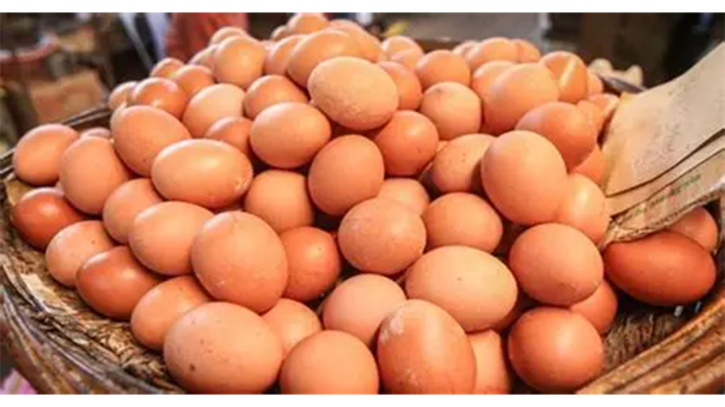
Retail egg prices in Jashore’s markets have jumped by Tk 2.50 a piece in a single week, adding fresh pressure to the food budgets of low- and middle-income families who rely on eggs as an affordable source of protein.
One government official has defended the price increase as consistent with rising production costs. But the head of another government office, along with small-scale farmers, has called the increase unjustified. They allege that corporate groups that produce farm eggs are manipulating prices, and that price swings and instability are being driven by “syndicate activity” among those involved in the supply chain from farm to retailer, a group the industry refers to as the “media,” meaning middlemen.
Because no effective marketing and supply system has developed, farmers cannot sell eggs directly in the market without going through these middlemen. As a result, the small-scale farmers who invest capital and labor in producing eggs are never able to set their own prices.
Buyers, meanwhile, say beef and mutton have been off the menu for many households for some time due to high prices. Pangas and tilapia, once affordable sources of animal protein, have also grown too expensive for many. Now even eggs, long the cheapest and most accessible protein source, have been hit by rising prices.
Farmers say production costs in the poultry sector have risen, as in other industries, due to higher costs for electricity, fuel, and other inputs including poultry feed and medicine, forcing them to raise prices somewhat compared to before. Even so, they say, they are selling eggs at production cost plus only a slim profit margin just to keep their farms running under the pressure.
Farmers believe eggs are being sold at excessive markups at the retail level, with corporate producers and middlemen manipulating prices to capture profits, leaving farmers without a fair price even as retail consumers face higher costs.
Industry sources say middlemen have once again stepped up activity in the market, as in the past, raising fears that retail egg prices could rise even further beyond what higher production costs alone would justify.
Sabbir Hossain, owner of Bismillah Agro, a farm in Raipur village in Jashore’s Bagharpara upazila, said the price of layer or poultry feed has risen by Tk 2 per kilogram, or up to Tk 100 per sack. Frequent power outages have also forced him to run a generator daily, while rising electricity and fuel prices have pushed up production costs further.
Sabbir Hossain said corporate firms effectively control egg prices in the market, while middlemen earn a profit of Tk 0.50 to Tk 1 per egg, with prices rising further as eggs change hands multiple times at the retail level. He said selling without going through middlemen is not feasible, since it isn’t practical to transport thousands of eggs from market to market by vehicle to sell directly; the lack of an organized market system leaves farmers with no alternative. He said petty traders buy eggs from his farm at Tk 10.50 apiece, and considers it unjustified that the same eggs then sell in the market for Tk 13 to Tk 14.
A visit to grocery shops in Jashore town found eggs selling at Tk 12.50 apiece, with rural markets charging as much as Tk 14 apiece. At wholesale depots on the town’s Jail Road, prices ranged up to Tk 12.90 apiece depending on size.
Sirajul Islam, owner of the Bhai Bhai Enterprise egg depot, along with Akram Hossain Pappu of Bismillah Egg House and Sheikh Kuddus Ali of Mayer Doa Egg Store, said wholesale suppliers were currently charging Tk 11.70 per piece for Afil Group eggs, Tk 11.21 for Kazi Group, Tk 11.30 for Pabna Group, Tk 11.90 for Sirajganj Group, Tk 11.70 for Chand Group, Tk 11.90 for Mega Group, and Tk 11.60 for CP Bangladesh, with retailers then adding Tk 0.50 to Tk 0.90 per piece in markup before selling to consumers.
According to the district livestock office, annual egg demand in the district exceeds 510 million, against production of roughly 530 million eggs. The district currently has 130 active layer-hen farms.
Even though production exceeds demand in the district, consumers are not seeing the benefit; instead, a wide gap has emerged between production cost and retail price.
Dr Siddiqur Rahman, Jashore’s district livestock officer, said feed for a single egg-laying hen costs about Tk 9.80 a day. Not all hens lay eggs every day; on average, about 80 percent do. Add the cost of chicks, medicine, electricity, infrastructure, and labor, which comes to roughly another Tk 1.84, and the total production cost per egg comes to Tk 11.54.
Price pressure, and questions over oversight
People across income groups say the rise in egg prices, like other affordable animal-protein staples, is straining household budgets. Sajjad Hossain, a buyer at a large market in the Upashahar area of the city, said prices for everything are climbing; even cheap fish like pangas and tilapia are now out of reach, and now egg prices are rising too, making daily life increasingly difficult as food costs climb.
At the Rail Bazar area of the city, another buyer, a domestic worker named Jorina Begum, said she can no longer afford to feed her children meat or fish. She used to boil an egg to make a potato-and-egg curry, or fry an egg to go with rice when that wasn’t possible, but now even that has become difficult to afford.
Kishore Kumar Saha, a senior agriculture marketing officer, said he had formally notified the Director General of the Department of Agricultural Marketing in writing about the price increase, so that a fair price consistent with production costs could be set.
He added that raids had been carried out at two egg-producing companies in Jashore, and that senior district administration officials had been asked to review those companies’ production-cost records. He said doing so would help establish the true production cost and whether their pricing is justified, and would help explain why an egg that cost Tk 10 suddenly rose to Tk 12.50. He said corporate producers were responsible for destabilizing the egg market.
বাংলায় মূল প্রতিবেদন পড়ুন · Read the original Bengali report