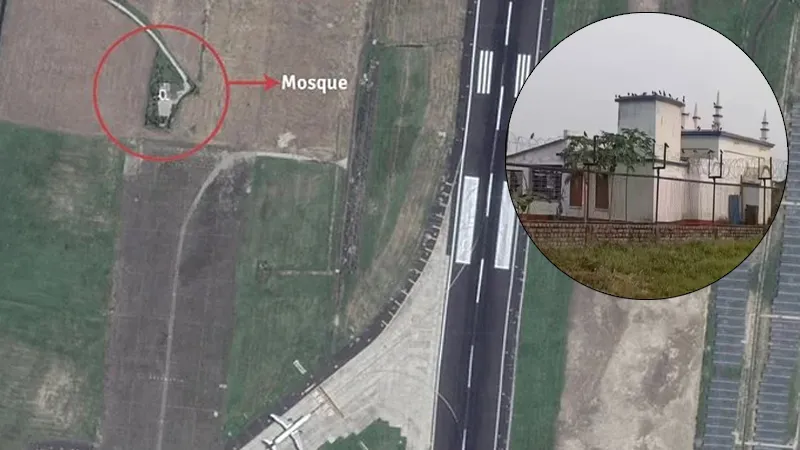
The Airports Authority of India (AAI) has moved to relocate the century-old Gouripur Mosque, which stands beside the second runway of Kolkata’s Netaji Subhas Chandra Bose International Airport. The step follows a meeting of a special inspection team and a security committee and, officials said, was taken on the basis of a consensus among the mosque committee, the AAI, local representatives and the local Muslim community.
The relocation work could begin as early as Saturday (July 11); a special notification has halted prayers at the mosque from that day. While mosques have been vandalized at various times in different Indian states, the Gouripur case is different, being a consensual relocation.
The 136-year-old Gouripur Jame Mosque – known to many as the “Bakra Mosque” – is currently seen as a major threat to the airport’s safety because of its location. Sitting right beside the second runway, it can create a visual illusion for pilots when visibility drops in heavy rain or dense fog, raising the risk of a serious accident, according to airport sources. International aviation has strict safety norms; the sources said the mosque stands just 165 meters from the airport’s secondary runway, whereas the rules require any structure to be at least 240 meters away.
Because the structure is so close to the runway, a modern Instrument Landing System (ILS) could not be installed, sharply limiting the airport’s flight-handling capacity, those concerned said. The touchdown point of the secondary runway had to be brought forward and shortened, and large aircraft could not use it. Relocating the mosque would remove these obstacles at a stroke and clear the way for infrastructure modernization, they said.
The Kolkata airport authority had earlier said that after the current Hajj season the old terminal building used before 2013 would also be demolished. Once the old terminal is pulled down, a new terminal built and the second runway made fully operational after the mosque’s relocation, the airport’s annual passenger capacity would rise to about 40 million (4 crore), officials said. The mosque has held up expansion of the second runway for nearly 30 years.
Sources said the relocation had been discussed repeatedly for more than three decades, but that local resistance and what they called the laxity of the previous Left and Trinamool governments had kept airport security from being prioritized. A recent change of government in West Bengal reopened the discussion. Because many people offer Eid prayers at the mosque, the state government and airport authority had wanted to respect their sentiments and decided to take a final decision after Eid. The matter has been kept highly confidential for fear of local tension, and the area has been placed under heavy security.
In an earlier statement, the mosque committee said: “We do not want any harm to the airport or any disruption to its safety because of us. The airport authority has offered to build us a bigger mosque outside the airport. But we are not, at this moment, in a position to take a final decision to relocate.”
Local legislator Sourav Sikdar said worshippers were not issued any pass but were taken to the mosque beside the runway after depositing their Aadhaar cards. “You know how many fake Aadhaar cards were issued under the previous government – it creates a security crisis,” he said, adding that CISF personnel had to be deployed for worshippers and a bus kept running at all times. The runway could not be expanded because of the mosque, he said, so large aircraft could not land, causing financial loss, no new jobs and no development, while also posing a major security threat. “We have told the mosque committee to identify other Airports Authority land outside the runway, and we will provide it,” he said.
Kolkata airport opened in 1924. The land is ancient waqf property, acquired by the Airports Authority of India in 1962 for airport expansion. Jessore Road, then beside the mosque, was rerouted for the airport, leaving the mosque inside the airport wall next to the runway. As a condition of the 1962 acquisition, a small iron gate stands opposite the Gouripur Kali temple on Jessore Road, with a CISF watchtower above it; ringing the gate’s bell opens it for those wishing to pray. After their Aadhaar cards are verified, the airport authority takes worshippers to the mosque by special bus – four buses in each of three daily shifts. Without this special arrangement, reaching the mosque is virtually impossible for ordinary people. Jessore Road is roughly 3 kilometers from the mosque.
বাংলায় মূল প্রতিবেদন পড়ুন · Read the original Bengali report