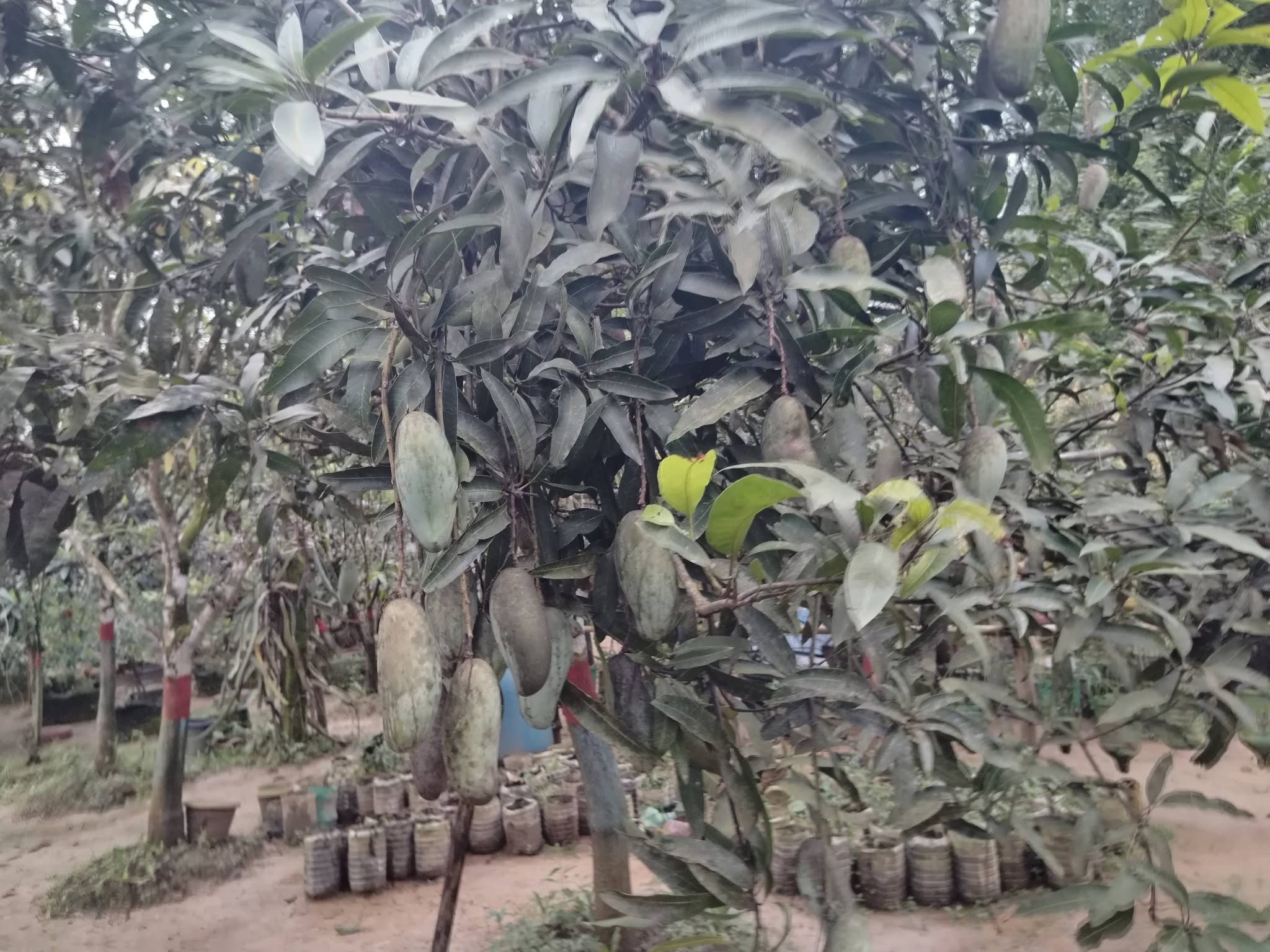
Saria village lies in the South Shahbazpur union of the Borlekha upazila in Moulvibazar. On a hill slope in that village, an eye-catching fruit orchard has been built, planted with 50 varieties of mango. And not just mango: with local and foreign varieties together, the orchard has become a collection of more than 100 types of fruit.
This is the quiet achievement of Rezaul Karim Khondoker, a teacher at a private educational institution. His journey began in 2017 with just a few mango saplings on a slope beside his house. Name tags hang from the branches of the trees in the orchard; on one side are rows of grapes and on another a strawberry field, while a peach tree stands tall beside longan, dragon fruit and salak.
Rezaul Karim said he had not started farming with a commercial purpose; the orchard had grown out of his love for plants, fruit and flowers. ‘I started planting mango saplings as a hobby. When the trees gave a good yield, I felt the urge to grow other varieties,’ he said. His first mango harvest raised his curiosity, after which he began collecting rare fruit saplings from various nurseries and cultivating foreign varieties. He said he had spent about 2.5 lakh taka bringing saplings directly from abroad.
Rezaul Karim’s two-acre orchard now holds 50 varieties of mango alone. Among the notable ones are Alphonso, American Kent, Himsagar, Cheng Mai, Pakistani Chosa, American Palmer, Summer Behesht, Surjodim, Nuch 1, 2 and 3, Baishakhi, Bandi Nuri, Gouromoti, Katimon, Thai Kanchamitha, Kunai, BAU 3, BARI 11, Nam Dok Mai, Harivanga, Blackstone, Mahachanak, Kew Sai, Brunei King, Banana, Amrapali, Honeydew, BARI 4, Jhai Sai, Nam Dok Mai Yellow, Nam Dok Mai Moon, Sitabhog, Ambika, Valencia Pride, Austin, Sada Punai, See-Muang and Sarenga.
Another part of his orchard is given over to 10 varieties of malta and orange, including Cara Cara orange, Washington Navel, South African Hallam malta and Sylheti orange. Beyond this there are also pomegranate, persimmon, apple, rambutan, blackberry, locket, jamrul, rose-apple, Turkish mulberry, cashew, custard apple, sharifa, Brazilian guava, honey kumquat and plum. And that is not all.
Two fruits in the orchard draw particular attention. Rezaul brought the fruits ‘Honey Kapoor’ and ‘Chupa Chupa’ directly from Indonesia. Honey Kapoor looks much like litchi, he said, but turns jelly-like when fully ripe, while Chupa Chupa is much prized for its sweet taste. Neither of these two fruits is commonly seen in Bangladesh.
Alongside the fruit, Rezaul’s orchard has various vegetables. For his own family, he grows beetroot, Chinese carrot, black tomato, red radish, strawberry tomato, cherry tomato, capsicum and several varieties of chilli.
The Borlekha upazila agriculture officer, Md Monowar Hossen, said Rezaul’s planned effort to collect and maintain foreign varieties was praiseworthy. ‘This initiative is excellent. The yield has been quite good this time, and some mango varieties have given a good harvest. He has collected saplings not just from various parts of the country but many foreign ones too,’ he said.
Many people are now flocking to see Rezaul’s orchard. A local resident, A J Lavlu, who recently visited it, said: ‘We had never seen such a fruit orchard in our area before. The care and patience with which he has built it is truly worth emulating, and many are drawing inspiration from him.’
Rezaul said he had no plan for commercial cultivation right now, though it might happen in future. He is testing which foreign fruit varieties give a good yield in the soil and climate of Moulvibazar. ‘New fruits arrive every year, and they have to be kept with great care. If the yield is good, I will start commercial cultivation later,’ he said.
বাংলায় মূল প্রতিবেদন পড়ুন · Read the original Bengali report