A job in the BCS cadre, a teaching post at a government college, senior positions at multiple banks — all of these were open to Ekhtiar Uddin Ahmed Munna. A path into business was open to him too. But none of it, in the end, could hold him back. Driven by a desire to do something for agriculture and the people of his own area, he left a secure job behind and stepped into farming.
About two years ago, he set up an integrated agricultural farm called “MM Agro” in Chartheki village, Pakundia upazila, Kishoreganj. The farm simultaneously runs fish farming, poultry rearing, cattle fattening, napier grass and vegetable cultivation, and vermicompost production. Waste from one project on the farm is used as a resource for another. This is lowering production costs, creating jobs, and — through organic fertilizer production — working to protect soil health.
From a career to the farm
After completing his studies in the accounting department at Dhaka University, Ekhtiar secured a position in the education cadre through the 22nd BCS. He was posted to Gurudayal Government College in Kishoreganj. But instead of joining the education cadre, he went into banking.
He worked at various banks, including UCBL, Pubali Bank, Uttara Bank and Dutch-Bangla Bank, including as a manager. In 2016, he left banking to go into business, and was involved in various ventures including contracting, construction and garments. Later, he began thinking about agriculture’s potential. That thinking led him to start MM Agro in Chartheki.
Ekhtiar said: “I come from a commercial background. I didn’t have much prior experience in agriculture. I’ve had to learn a great deal doing this work — learning through setbacks along the way. I consider that learning itself an investment in the future.”
Many projects on one farm
MM Agro’s operations are centered on roughly 18 to 20 bighas of land. It has four fisheries, where various species of fish are farmed. There are around 2,000 Fawmi chickens. Bull fattening is under way. Napier grass is grown as livestock feed. Alongside this, vermicompost is produced from livestock waste and organic material.
But the distinctive feature of Ekhtiar’s venture isn’t simply running this many projects at once. His plan is for the output of one project to feed into another.
Napier grass is used as feed for cattle, goats and grass carp. Livestock waste and other organic material are used to make vermicompost. In other words, waste on the farm is being turned into a resource.
Ekhtiar said: “If you buy at 10 taka and sell at 9, no matter what business you’re in, there’s no profit. So the big question is how to cut production costs.”
He said: “Bangladesh is an agricultural country. Our economy depends on agriculture. So we need to deepen that dependence and further develop agriculture. I believe that’s what real development looks like — agriculture-based development.”
Vermicompost for soil health
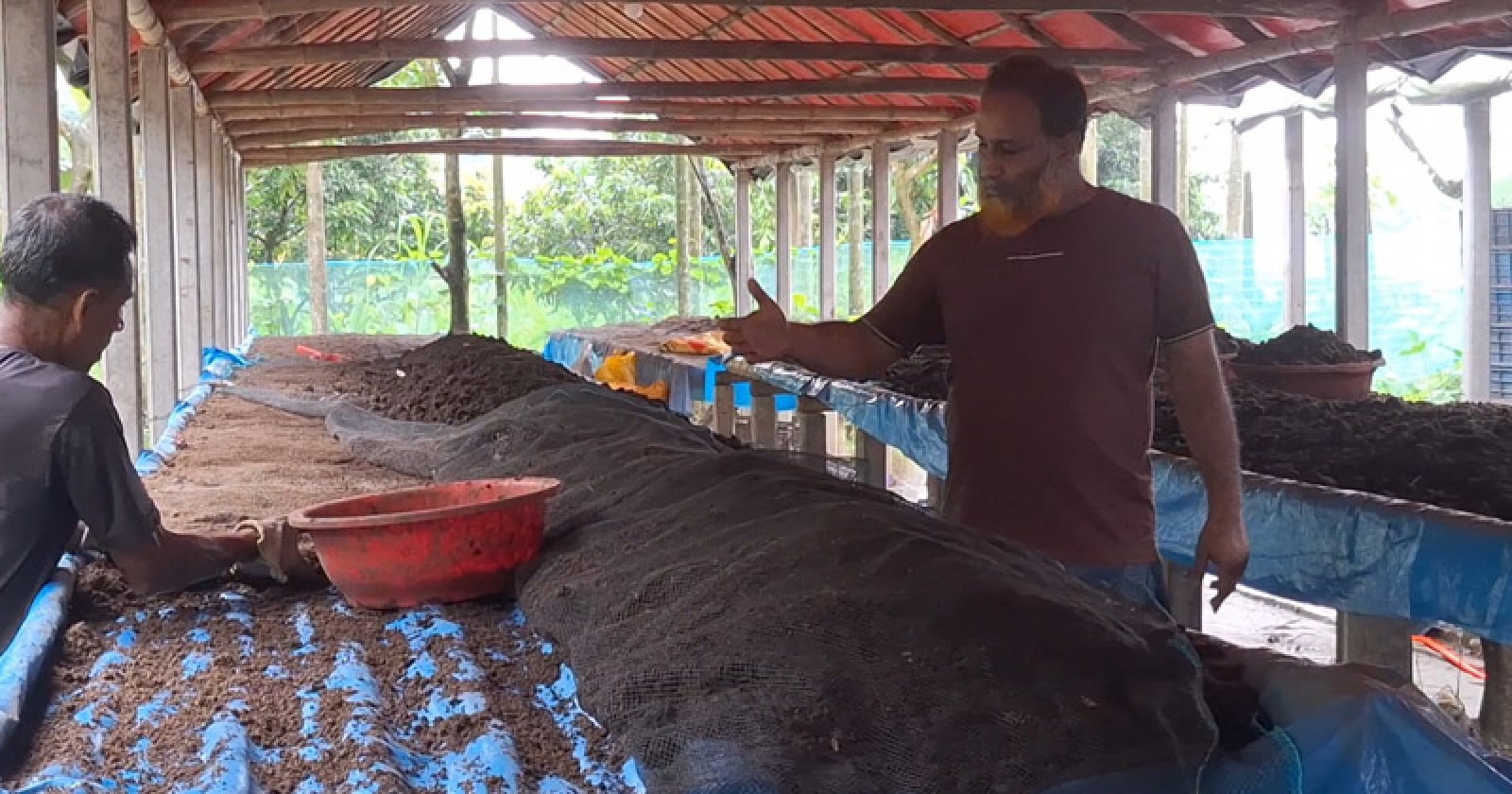
One of MM Agro’s most important projects is vermicompost. The fertilizer is produced using livestock waste and various organic materials. For the entrepreneur, this isn’t just a line of business — it’s tied to the future of agriculture itself.
Ekhtiar said: “Organic content in our soil is declining. Agricultural development isn’t possible without maintaining soil health. I want vermicompost to be made not just on my farm, but in households everywhere.” Work is currently under way to scale up production of this project, and he plans to eventually market vermicompost commercially on a larger scale.
Jobs built around the farm
MM Agro has also become a source of employment for local people. Around eight people, a mix of permanent and local workers, are employed across the farm’s various projects. The agriculture department says more local youths are involved in various other tasks, including the vermicompost project, beyond that core group.
Robi, a farm caretaker, said: “There are cattle, fish, vermicompost and poultry projects here. About eight of us work across these projects. Six of us work permanently, and two more are local workers.”
He said: “We’re paid regularly. If needed, we can take an advance from our pay before the month ends. The work includes cutting grass, collecting cow dung, gathering materials for organic fertilizer production, and feeding and watering the poultry.”
Ripon, another worker, said: “I’ve been working here for about a year. This work lets me support my family of four comfortably. The bigger the farm grows, the more work opportunities it will create for people.”
Students working alongside their studies
The farm employs not only full-time workers but also local students who work alongside their studies. Niloy, a student at Pakundia Degree College, is one of them.
Niloy said: “My grandfather works here. I work here alongside him in between college hours. There are four or five other students like me here who also work while studying.” He said: “The money we earn from this work helps cover our study expenses. Being able to earn something ourselves to pay for our education makes us genuinely happy.”
A retired soldier in charge of management
Overall management of the farm is handled by Badiul Alam, a retired army member. He joined the project after retiring from the army in 2015.
Badiul Alam said: “Who is doing what work, what needs to be done where — overseeing all of that is my responsibility. In short, I’m responsible for running the entire farm.”
On the vermicompost, he said: “If farmers use the fertilizer we’re producing, they’ll be able to grow better crops.”
Ekhtiar’s elder brother, Ilias Uddin Chunnu, sees his brother’s willingness to take a risk — leaving a secure career for agriculture — as the most remarkable part of the story.
He said: “My younger brother held a BCS cadre position and was a senior bank official. He left those secure positions behind out of a plan to do something for the development of his own area through agriculture.” They have not yet seen the profits they hoped for. Ilias Uddin Chunnu said: “Right now, we’re not seeing a profit. But he says we won’t retreat. If we don’t succeed once, we’ll try a hundred times. Success will come, little by little, over time.”
Optimism from the agriculture department
Pakundia Upazila Agriculture Officer Nure-e-Alam said: “Ekhtiar Uddin’s integrated initiative will bring a positive change to the village economy. His venture has already created direct and indirect employment for 20 to 30 people. In particular, 10 to 12 young people work every day at the vermicompost plant.”
He said: “The organic materials needed for improving agricultural quality and protecting soil health are also available from here. Local youths have also become involved in the fisheries and livestock sectors. As a result, this is creating local employment on one hand, while developing into a productive agricultural farm on the other.”
Bigger dreams ahead
Ekhtiar does not yet consider his venture a success. Instead, he wants to gradually expand the farm’s scope to build a full-fledged integrated agriculture model. He also plans to add dairy and other agriculture-based projects in the future.
Ekhtiar said: “Despite having other businesses, my interest in agriculture is stronger. I want to grow this further. Nothing happened in a day. I’ve added one project after another, gradually. I intend to grow it even bigger going forward.”
Ekhtiar’s MM Agro, born from his decision to leave a secure career for farming, has not yet reached the peak of success. But by linking fish, cattle, poultry, grass and vermicompost into a single production cycle, he is opening up new possibilities in agriculture while creating local jobs. His dream is that this small venture will one day grow big — and along with it, grow the scope for doing something meaningful for the land and its people.
বাংলায় মূল প্রতিবেদন পড়ুন · Read the original Bengali report