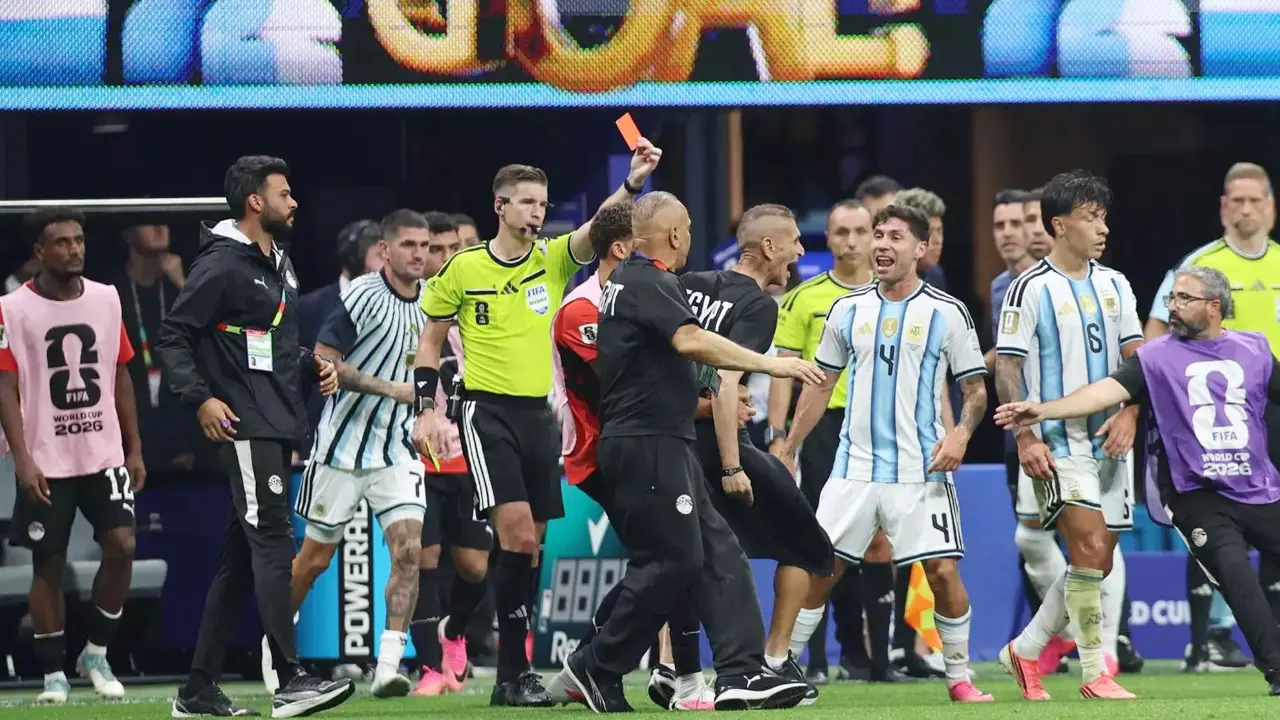
After fierce controversy over refereeing in Argentina and Egypt’s World Cup round-of-16 match, FIFA has issued a formal explanation. Pierluigi Collina, world football’s governing body’s chief refereeing officer, said match officials’ decisions are independent and never subject to outside influence. “A foul is a foul,” he said, no matter how long before the goal it occurred — if VAR detects it, it will inform the referee.
Egypt led 2-0 until the 78th minute of the match. Argentina then staged a dramatic comeback led by Lionel Messi to win 3-2. But an Egyptian goal was disallowed and a late penalty appeal was rejected, prompting fury from coach Hossam Hassan and Egypt’s players, who also questioned the neutrality of referee Francois Letexier and VAR.
In an interview published on FIFA’s official website, Collina said: “Only eight matches remain at the World Cup. Overall, we are satisfied with the standard of refereeing. When so many matches are officiated in such a short time, some things may not go exactly as planned. But match officials learn from those moments and prepare themselves even better.”
Rejecting questions about referees’ integrity, he said: “Constructive discussion about a referee’s decision is always possible. But there is no room for baseless allegations. The integrity of match officials should not be questioned. Such allegations often become a threat to them and their families as well.”
Collina also made clear that FIFA president Gianni Infantino cannot influence referees’ decisions either. “The claim that refereeing operations are directed by anyone — even by the FIFA president — is not true,” he said. “Match officials carry out their duties completely independently, and like players and coaches, they always try their best.”
On Egypt’s disallowed goal, Collina said VAR reviews the entire attacking possession phase before every goal. If a foul is detected before the goal and it is connected to the goal, the referee is advised to go to the pitch-side monitor and review the footage before deciding. How far from the goal, or how long before it, the incident occurred is not a factor.
Explaining the specific incident in the Argentina-Egypt match, he said: “Egypt’s number 19, Marwan Attia, clearly stepped on the foot of Argentina’s Lisandro Martinez. In our view, this is a foul. Even if the referee did not see it on the pitch, VAR can detect it and intervene.”
Collina also explained Egypt’s late penalty appeal involving contact between Mohamed Salah and Julian Alvarez. “If a defender touches the ball first and then normal footballing contact occurs, it is not considered a foul,” he said. “In that incident too, both the referee and VAR considered it normal footballing contact.”
He acknowledged, however, that some decisions inevitably involve an element of individual judgment. But the renowned former Italian referee said FIFA remains satisfied with the consistent application of the same principles throughout the tournament.
বাংলায় মূল প্রতিবেদন পড়ুন · Read the original Bengali report