Thousands of cancer patients in Gaza are being denied life-saving treatment because of Israeli restrictions on evacuating patients and bringing in medicine, according to Palestinian health officials and international agencies.
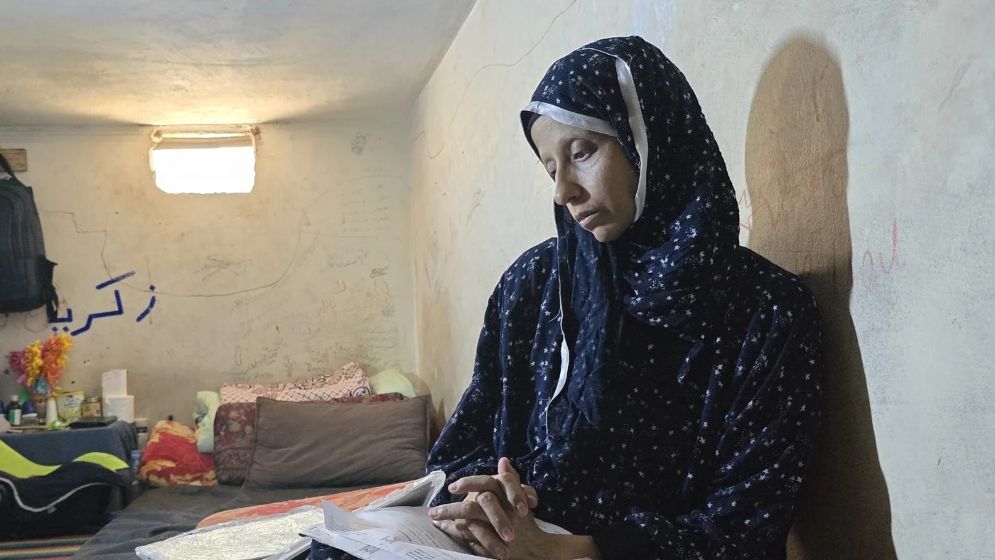
In a small, cramped space under the staircase of a southern Gaza school turned shelter, university professor Khulud Abu Sahmoud is slowly losing her battle with cancer. After 15 chemotherapy sessions, the 33-year-old Palestinian mother of two was told she could not continue treatment because the drugs now available in the war-torn enclave are not suited to her type of cancer.
Speaking to Middle East Eye, Abu Sahmoud said her liver cancer had been diagnosed shortly after her daughter’s birth about nine months ago, but her condition only worsened after a few chemotherapy sessions. Doctors told her the treatment did not suit her body or her condition, she said; it never cured the cancer, only causing her hair and nails to fall out.
Nearly 10 months after the October 2025 ceasefire, Israeli authorities continue to restrict the entry of emergency, life-saving medicine and equipment into Gaza — including cancer drugs, chemotherapy, antibiotics, anaesthetics, laboratory and diagnostic equipment and surgical supplies. By March, about 46 percent of essential medicines and 66 percent of medical supplies in Gaza had run out, according to the UN and international agencies.
This month, the Palestinian health ministry said chemotherapy for breast, colorectal and gastrointestinal cancers, head and neck tumours and sarcomas had largely stopped as specialised drug stocks ran dry. It said at least 4,000 of Gaza’s roughly 11,000 cancer patients had been given medical referrals to travel abroad but were still waiting for permission to leave.
Dr Mohammed Abu Nada, director of the Gaza Center for Cancer, said the shortage of chemotherapy drugs was the worst in years, forcing doctors to use expired medicines — now also gone — and to rely increasingly on single-drug therapy, which reduces effectiveness and raises risks. There was not enough breast-cancer medicine even for current patients, he said, and nothing to offer newly diagnosed ones.
An endless wait
Abu Sahmoud’s referral was approved soon after her diagnosis because her treatment was unavailable in Gaza, but nine months on she is still waiting to leave. Doctors told her the care she needs is available in Jordan or Turkey, she said. Through referrals, Gaza patients can reach hospitals in the occupied West Bank, East Jerusalem, Egypt and Jordan; the Palestinian health ministry issues and funds them, but patients still need permission to cross Israeli- or Egyptian-controlled crossings.
Since the war on Gaza began in October 2023, Israel has tightened restrictions on medical referrals and evacuations, leaving thousands of critically ill and wounded Palestinians without adequate local care. Four months after the ceasefire, Israel partly reopened the Rafah crossing for medical evacuations to Egypt under strict controls, allowing only about 50 patients a day to leave, subject to Israeli approval. More than 20,000 people, including about 4,000 children, are waiting for urgent medical transfer, the ministry says. Since Rafah reopened in February, only 1,655 patients had been evacuated as of June 30, while more than 1,570 people have died waiting for permission to leave since October 2023.
Abu Sahmoud said her health worsened by the day amid the endless wait, with countless patients ahead of her. She has trouble breathing, her abdomen is swollen with fluid, and she has lost about 20 kg; at times she cannot eat as the fluid builds up. The mother of a five-year-old son and a nine-month-old daughter said she had not once been able to hold her baby since giving birth. “I can’t fulfil any of my duties toward my children. Illness has left me bedridden… I am slowly heading toward death,” she said.
Many patients awaiting transfer have deteriorated as Israeli attacks crippled Gaza’s health system and repeated displacement forced people into crowded shelters with little clean water or sanitation. Abu Sahmoud said she had been forcibly displaced about 30 times after her home was destroyed. Most recently she was forced into a tent in the Mawasi al-Qarara area west of Khan Younis, where her health began to decline, before moving in with her displaced elder sister, who lives under the staircase of the Ahmed bin Abdul Aziz school; about 10 people from their two families now live there together.
Beside her bed sits a box of medicine hidden from rats, and a bag holding some 50 academic certificates earned over years of study. Once known to family and friends as a bookworm, Abu Sahmoud said the Islamic University of Gaza had honoured her as the first student in its history to finish a two-year master’s programme in one year and four months, before she began a PhD and joined the same university as an assistant professor in curriculum and teaching methods. “I love learning. My whole life was devoted to education… But this illness has taken everything from me. The hardest part is this wait for treatment, with no end in sight,” she said.
বাংলায় মূল প্রতিবেদন পড়ুন · Read the original Bengali report