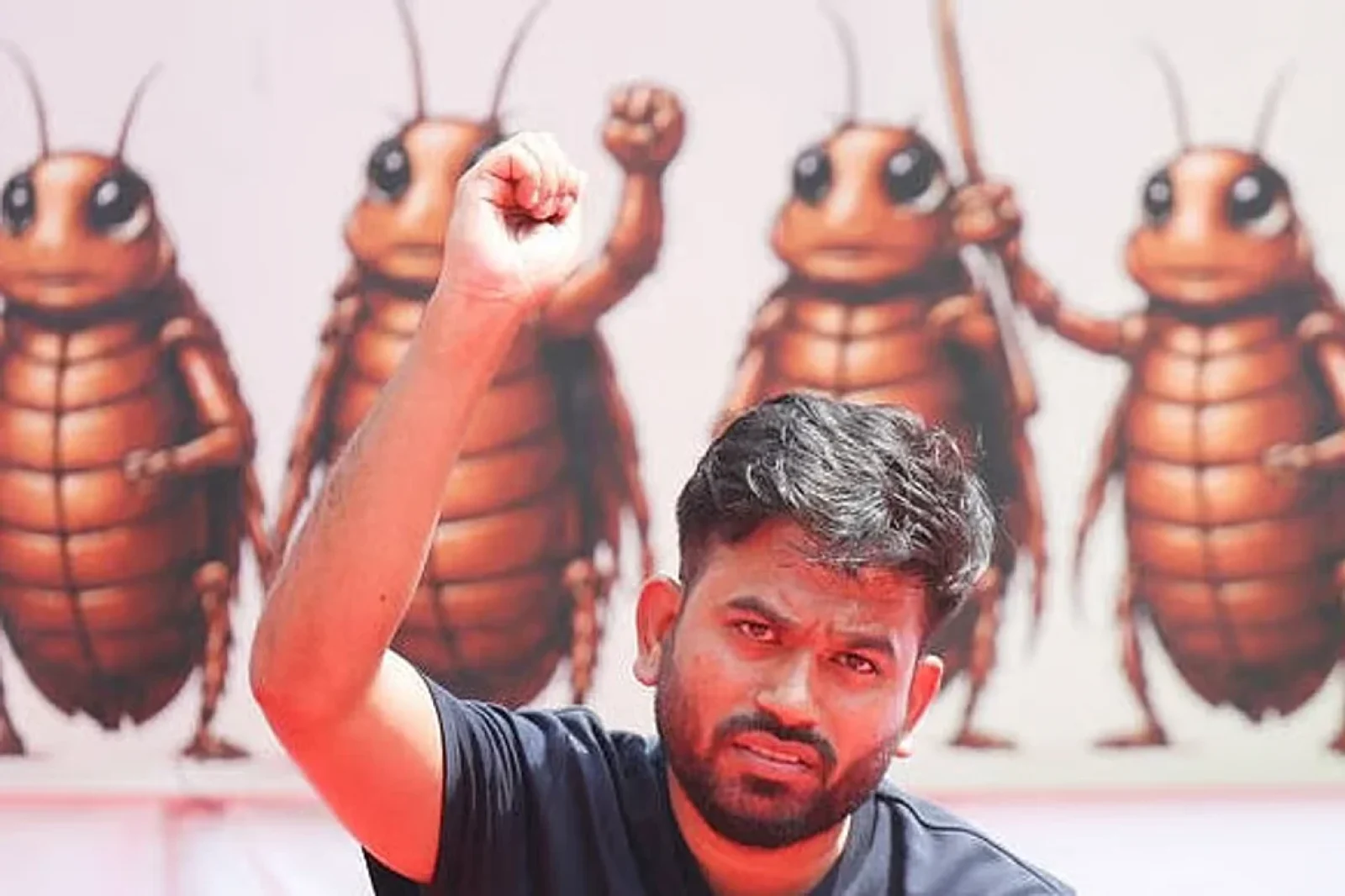
Leaders of the Cockroach Janata Party (CJP), a movement led by young people of the Gen-Z generation in India, have again threatened to take to the streets. They said they would return to the streets unless everyone arrested after the protests were suspended is released immediately.
India’s education minister, Dharmendra Pradhan, was recently forced to resign in the face of weeks of sustained protest by the CJP. It was a major blow to the government of India’s prime minister, Narendra Modi, because only one minister had resigned in Modi’s 12 years in power before this.
The CJP, which has become known in the country as the “cockroaches,” had called the protest at Jantar Mantar in New Delhi demanding accountability from the Indian government after millions of students were affected by the leaking of entrance examination papers at several educational institutions. It demanded the resignation of Dharmendra Pradhan as education minister. Thousands of students joined the protest along with members of the public. The protests spread to other parts of the country as well as New Delhi.
The CJP’s movement was withdrawn after the education minister announced his resignation in the face of the protests. The party alleges, however, that more than 100 people have been arrested across the country since the movement was suspended, and that many of them have been charged under non-bailable sections.
A CJP spokesperson, Sourav Das, said the Modi government had given an assurance that no punitive action would be taken against any protester now or in future. The nationwide protests were withdrawn on Saturday on that basis.
On Monday the CJP warned the Modi government not to go back on its promise. The party said it had received reports that students were being detained in the eastern state of Assam, in West Bengal and in Bihar.
A CJP spokesperson, Ashutosh Ranka, said: “If the government does not honour the agreement and does not release all those detained or arrested, we will be forced to begin the movement again.”
Members of the All India Students’ Association (AISA), who took part in the Jantar Mantar protest, separately met Bihar’s police chief. They threatened to restart the movement if those arrested were not released.
Bihar police said on Monday that no punitive legal action would be taken against any of the protesters. They also announced that all cases filed up to 6pm local time on Sunday would be withdrawn. AISA said the Assam government had also withdrawn cases and released those arrested during the movement.
The West Bengal government, however, filed fresh cases on Monday over the display of “objectionable posters” at a rally held on Friday. Thousands of people took part in that rally. The state’s police have so far arrested 16 people, most of them Muslim.
Police have filed a complaint against the actor Sreelekha Mitra over allegedly holding a cartoon of Modi at Friday’s rally. Another person has been arrested for posting an “objectionable picture” of the Indian leader.
Delhi police have also reportedly begun monitoring social media posts abusing Modi. Police have asked three social media platforms to remove posts containing “objectionable language and offensive comments.”
An official told the news agency PTI on condition of anonymity that work had begun on identifying such content on various social media platforms.
Alongside the street protests, demonstrators were also vocal on social media. Instagram was flooded with satirical reels and memes about Modi. Several journalists, politicians and social media users have claimed their posts were quickly removed from the platform for criticising the government.
The CJP said on Monday that it had set up a legal fund to meet the legal costs of protesters charged in police criminal cases.
The protests began with the leaking of the paper for India’s medical entrance examination in May. On 20 July police carried out a violent crackdown on the demonstrators. In that situation the movement turned into a nationwide mass movement against the Modi government.
India’s chief justice, Suryakant, sharply criticised the excessive use of force by police against students. He said the Indian constitution gives the right to protest peacefully.
বাংলায় মূল প্রতিবেদন পড়ুন · Read the original Bengali report