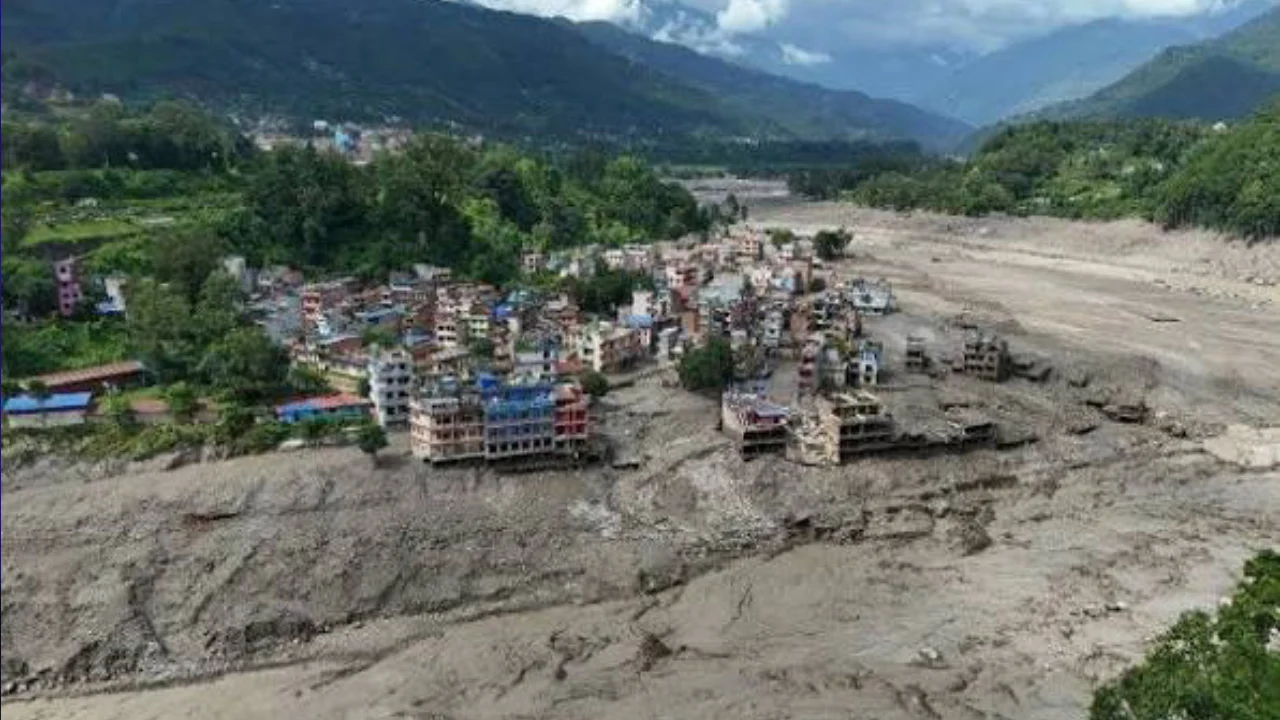
Nepal’s flash floods have caused enormous loss of life and damage, with more than 800 people still missing. Flash floods have previously made news in Bangladesh and other countries around the world as well. But what exactly is a flash flood? Why does it happen? And is there any way to predict it in advance?
What is a flash flood?
According to the Encyclopedia Britannica, a flash flood is a sudden, unexpected surge of water that flows rapidly through ravines, narrow gorges, valleys or other low-lying, narrow areas. Flash floods can occur anywhere. In an ordinary flood, river water typically rises relatively slowly — a week or more of continuous rainfall causes river levels to rise and become severe.
A flash flood, on the other hand, can bring devastating flooding from just three to four hours of rainfall, with river water going from dry to overflowing its banks almost instantly, said Sardar Uday Rayhan, executive engineer at Bangladesh’s Flood Forecasting and Warning Centre (FFWC).
Flash floods are often caused by heavy rainfall associated with thunderstorms, or by the rapid melting of snow and ice in mountainous areas. However, they can also be caused by dam failures. These floods are usually short-lived, with water levels rising and then falling again within hours to a few days — but their sudden onset can be extremely destructive.
According to Britannica, some flash floods generate such a powerful wall of water that it can scour riverbeds, tear structures from their foundations, destroy roads and bridges, and snap or uproot large trees.
Flash floods are among the deadliest weather-related events. More than 5,000 people die from them worldwide every year, most by drowning.
What causes flash floods?
Flash floods can be caused by many factors, but the primary cause is heavy rainfall. According to the US National Weather Service, flash floods can also be caused by dam failures or landslides. Factors such as rainfall intensity, location and coverage area can determine how quickly a flash flood occurs and which areas it affects.
Terrain characteristics can also influence how quickly water levels rise and how widely a flood spreads. Steep terrain, such as hills or mountains, and large areas of surfaces that cannot absorb water — such as hard soil, rock, rooftops, roads and other paved areas — can cause water to flow more quickly and flood low-lying areas.
Similarly, areas where recent wildfires have burned away extensive vegetation also carry a higher flash-flood risk. In contrast, water flows relatively slowly across terrain with gentle slopes, dense vegetation and soil capable of absorbing water. A warmer climate can also increase the frequency and severity of flash floods.
As average air temperature rises, so does the atmosphere’s capacity to hold moisture, or water vapor. Research shows that for every 1 degree Celsius (1.8 degrees Fahrenheit) of warming above pre-industrial temperatures, atmospheric moisture density can increase by about 7 percent. This extra moisture can lead to heavier rainfall.
As a result, areas already prone to flash flooding from heavy rain may see such events occur more frequently and with greater intensity. While many believe climate change played a role in what happened in Nepal, scientists say it’s still too early to say so definitively.
Is it possible to predict flash floods in advance?
According to experts, flash floods, like seasonal floods, can be predicted. But the main challenge in this case is time. In other situations, overall conditions allow for advance warning with time to prepare, but because flash floods happen so suddenly, that window is extremely limited.
“The main reason is that major river basins are typically large, and data availability is easier there. Flash floods, on the other hand, typically occur in mountainous basins, where there’s a data shortage,” Rayhan said.
That means the scarcity of hydrological or meteorological stations for transmitting data from remote mountainous areas makes it especially difficult to obtain timely information during a flash flood. Rayhan said that, according to the World Meteorological Organization’s (WMO) definition, a 24-hour advance forecast is considered a “reliable lead time.”
Work is under way to reduce disaster risk using technologies such as radar, satellites and automatic sensors. On this, Sudip Thakuri, an associate professor at Tribhuvan University in Nepal, said that while such natural weather events cannot be prevented, loss of life and property damage can be reduced through precautionary measures.
“Early warning systems are being used. These systems, installed on and around glaciers, provide real-time information on lake water levels and dam conditions. Getting advance information about such events can help reduce loss of life,” he said. However, he said, even where “early warning systems” are effective, greater coordination is needed at the government level for events of this international scale.
Regarding Wednesday’s flash flood in Nepal, Basanta Adhikari, director of the Disaster Studies Center at the Institute of Engineering Studies, Pulchowk Campus, Tribhuvan University, said: “If (the flood) had originated from within Nepal, we would have been able to see it from here. But for the kind of events we’re now witnessing, the international data-sharing system needs to be strengthened further. At the moment, that doesn’t appear to be happening.”
“There is no human settlement in the areas where these events occur. Since it’s difficult to exchange information through people there, satellite stations should be installed to monitor the situation from there,” the official said. “Otherwise, we will be the ones who suffer the most damage, because our settlements are located downstream of the (Nepal-China) border.”
Such systems have been installed in some of Nepal’s river basins, but experts say their use in the Himalayan region is still at an early stage. Thakuri of Tribhuvan University said: “Risk-prone areas can also be identified and riverside settlements relocated elsewhere. The most effective measure to prevent loss of life and property damage is not to build settlements in high-risk areas in the first place.”
বাংলায় মূল প্রতিবেদন পড়ুন · Read the original Bengali report