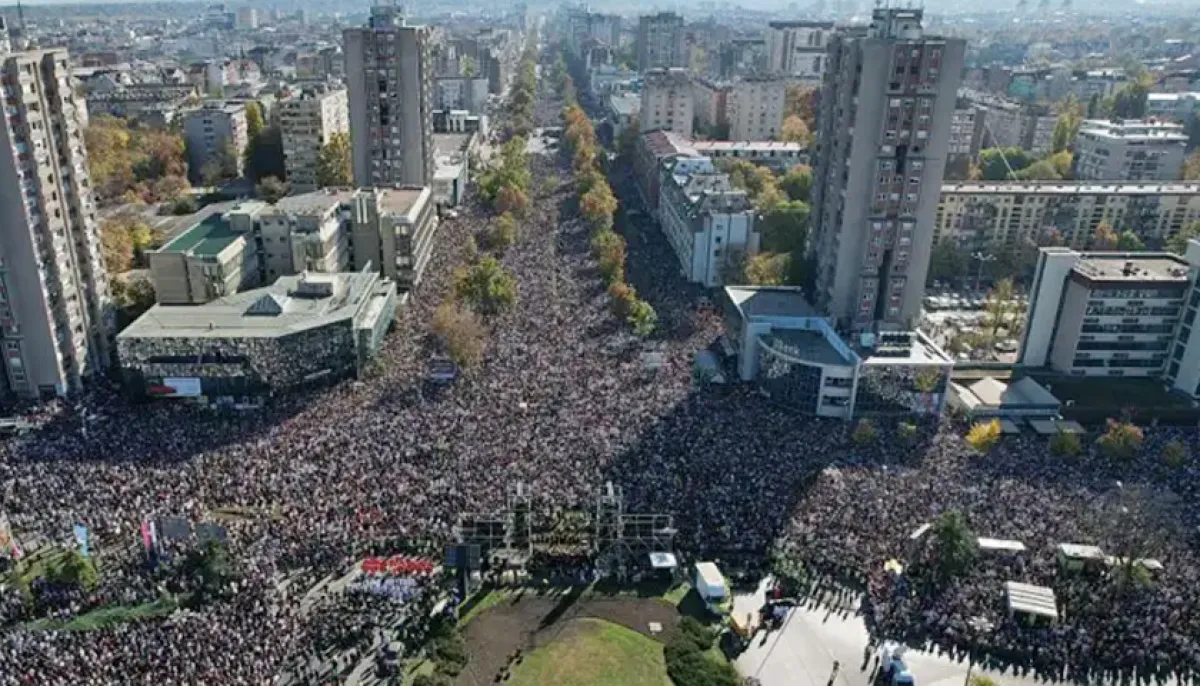
Serbian President Aleksandar Vucic has resigned after more than a year of student-led protests over corruption allegations against the government and growing public anger.
In a speech to supporters outside the presidential residence in the capital, Belgrade, Vucic said he had maintained peace and stability in the country during his nine years in power.
He had announced his intention to resign in June. He will now contest as his party’s candidate for prime minister in the upcoming parliamentary election.
Under Serbia’s constitution, Vucic cannot run for a third term as president.
During his time in power, the pro-Russian populist leader’s government faced allegations of irregularities and corruption, fueling public anger in Serbia.
The 2024 collapse of the roof at the Novi Sad railway station, which killed 16 people, intensified anger against his first government.
Protests then began with participation from different sections of society, from students and teachers to workers and farmers.
After renovation, the Novi Sad railway station had been expected to become a symbol of Serbia’s progress.
But opposition figures see the roof collapse and casualties there as a picture of more than a decade of rule by Vucic’s Progressive Party.
After protests began across the country, one official after another at different levels of Vucic’s government resigned in an effort to ease public anger and remain in power.
But that failed to calm demonstrators, and protests continued throughout the summer.
The situation grew more volatile when the government eventually deployed police to suppress the movement.
At that time, police faced various allegations of assault, abuse and repression.
Protesters demanded the resignation of the Vucic government and called for a vote to elect a new president.
Vucic’s presidential term had been due to end next year. But because he resigned before completing the term, Serbia will now hold a new presidential election.
Under the country’s constitution, the next presidential election must be held within three months of the current president’s resignation.
Meanwhile, parliamentary elections are scheduled to be held toward the end of October. That means Serbians will go to the polls twice this year.
In his speech, Vucic said the presidential election would be held a little more than a month after the parliamentary election in October.
He plans to contest the upcoming parliamentary election for the post of prime minister. That could allow him to retain his position at the top of the Progressive Party.
Parliament Speaker Ana Brnabic, who is also a Progressive Party leader, will serve as interim president until a new president is elected.
According to Serbia’s state broadcaster RTS, before resigning Vucic used his constitutional powers to pardon 49 people. They included 23 students and loyal activists from his party.
Many of those pardoned had faced serious criminal allegations.
One of the parties expected to compete against Vucic’s Progressive Party in the upcoming parliamentary election is Students Win.
The party was formed by students who led the recent anti-corruption movement.
Another alliance, known as European Serbia, brings together mainly pro-Western opposition parties.
For more than a decade, Vucic has been an integral and important figure in Serbian politics. He became prime minister in 2014 and was elected president for the first time three years later, in 2017.
Vucic has said openly that he wants to connect Serbia with the European Union.
At the same time, he wants to maintain close relations with Russia and keep Serbia open to Chinese investment.
বাংলায় মূল প্রতিবেদন পড়ুন · Read the original Bengali report