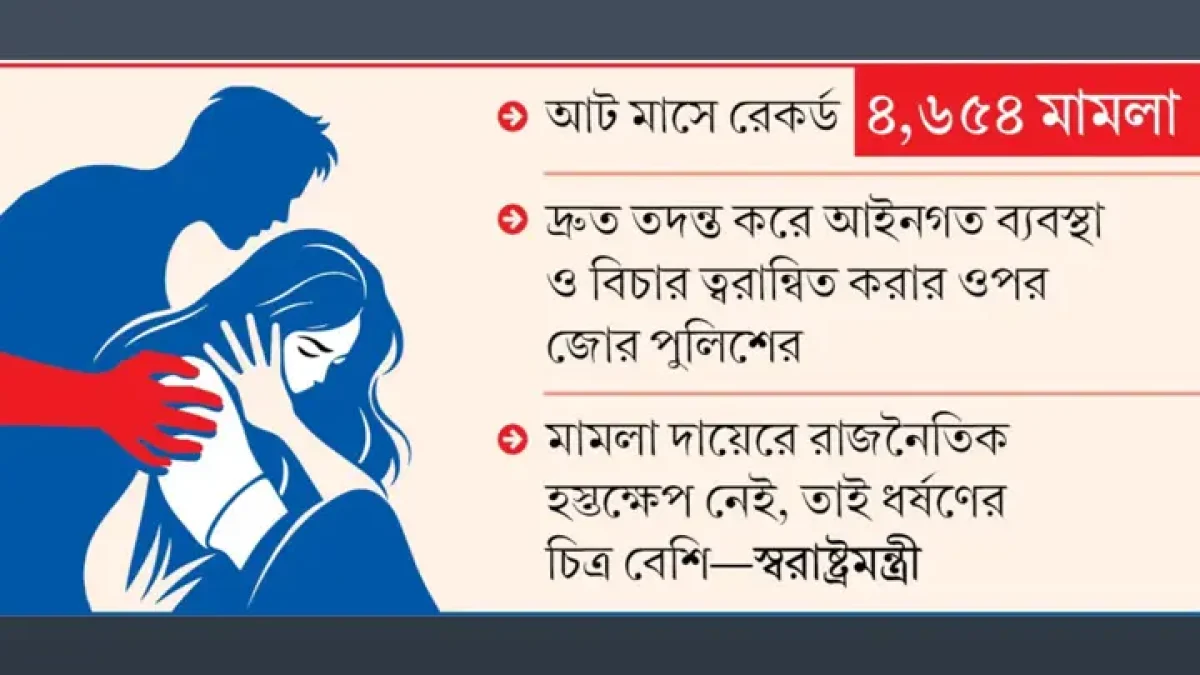
Rape reports and cases have risen at an alarming rate across Bangladesh. Police recorded 4,654 cases in the first eight months of this year, the highest total in several years, and said investigations found links in most reported incidents. All police units have been instructed to investigate such cases thoroughly and submit reports quickly to accelerate trials.
Analysts attributed the rise to the reckless conduct of people under political protection, some leniency by law enforcement, weak preventive capacity and social instability.
Government officials, however, said there was no political interference in filing cases, allowing survivors to report complaints at police stations without obstruction and increasing the recorded total.
They said no offender was being spared because of party identity, with the government taking legal action and political parties also imposing immediate organizational measures.
Police headquarters reports show that 4,654 rape cases were recorded at police stations during the first eight months of the year. There were 3,252 cases from January through June, including 1,940 from March through June and 1,312 from January through March. Police recorded 707 cases in July and 695 in August.
There were 1,528 rape cases from March through June last year. The number in those three months was 628 higher than in the first three months of that year. This year’s March-June total was 412 higher than during the same period last year. Police stations under Dhaka Metropolitan Police recorded the most cases from March through June.
Chattogram city recorded 64 cases, while Gopalganj and Cox’s Bazar each recorded 62, Dhaka district 58, Tangail 57, Cumilla 53, Chattogram district 50 and Bogura 47.
At a recent senior police meeting, Additional Inspector General for Crime and Operations Khondkar Rafiqul Islam called the rate of increase deeply concerning. He instructed all police units to conduct thorough investigations and submit reports quickly.
Home Minister Salahuddin Ahmed recently said more cases were being recorded because survivors had previously been unable or unwilling to approach police due to social and political interference. They can now file a first information report as soon as they reach a police station, he said.
The minister said sweeping changes had been made in arrests, charge sheets, witness presentation and other trial processes. He cited the trial over a child’s killing in Pallabi, completed within 15 to 17 days, as a record for Bangladesh.
Several rape cases have drawn nationwide attention since the current government took office. A 7-year-old child was raped and killed in Pallabi, Dhaka, on May 19, and a 4-year-old child was raped in Bakalia, Chattogram, on May 21. A grade-four student was raped and killed in Pabna on September 9, after which her body was dismembered and left in a pond. A madrasa student and her grandmother were killed during a rape attack in Ishwardi, Pabna, on February 27. A mother of two was raped in Sreepur, Gazipur, on September 24 and later attempted suicide.
Investigations have also found direct political links among accused people. Police arrested Chougachha Government College Chhatra Dal Senior Joint General Secretary Arafat Hossain in Jashore on August 4 in a rape case. Chhatra Dal leader Hossain Ahmed was arrested in Nabiganj, Habiganj, on June 3 on an allegation of raping a homemaker. Swechchhasebak Dal leader Ismail was arrested in Shubhadya, Keraniganj, on September 9 over an allegation of raping a teenage girl.
A case was filed against five people, including Kendua municipal BNP Joint General Secretary Rafiqul Islam Bakul, in Netrokona on August 26. BNP leader Shokro Majhi was arrested on March 16 over an allegation of molesting a teenage girl. Jamaat leader Shafiul Hasan was accused of attempting to rape a student in Badalgachhi, Naogaon, on August 4.
Police arrested local Jamaat leader Mostafizur Rahman Mahbub in Mirzaganj, Patuakhali, on July 17 on an allegation that he attempted to rape a woman after offering her an amulet.
Two district police superintendents in Dhaka division, speaking on condition of anonymity, said investigations into most complaints had identified local activists from different political parties. They alleged that some committed the crimes while protected by politically influential people.
Police spokesperson and Assistant Inspector General for Media and Public Relations AHM Shahadat Hossain said offenders could no longer suppress cases. With no political or other pressure blocking complaints, a larger share of incidents was now being recorded, which could partly explain the statistical increase. He said police were applying a zero-tolerance approach, prioritizing rapid investigations, legal action, speedy trials and survivor safety.
Muhammad Omar Faruk, a professor in the Department of Criminology and Police Science at Mawlana Bhashani Science and Technology University, said the statistical rise was clear and the home minister’s explanation was partly accurate. Observations also showed offenders operating under political protection and some leniency by law enforcement, he said.
Faruk said unrestricted access to technology and harmful online learning were another factor. Most offenders were between 25 and 45 years old, while property disputes, revenge and an unstable social environment also contributed. He called for impartial investigations, punishment and effective preventive action before crimes occur.
বাংলায় মূল প্রতিবেদন পড়ুন · Read the original Bengali report