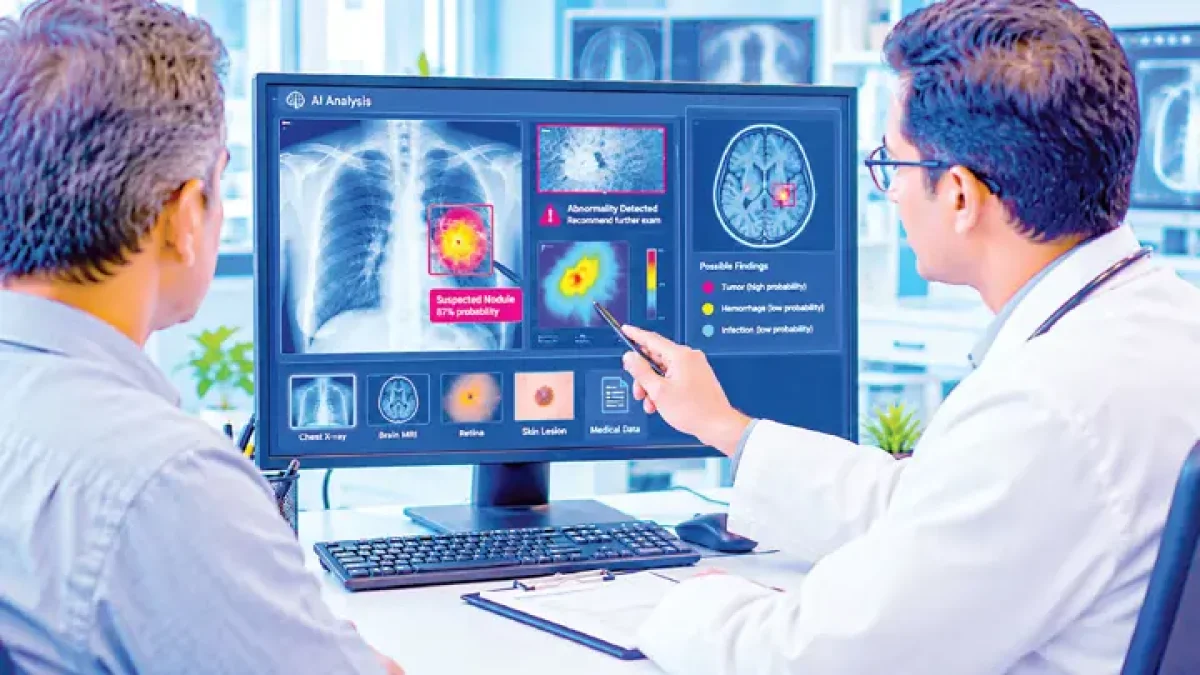
A patient arrives at a hospital while a doctor reviews the reports. At the same time, a computer analyzes an X-ray or scan, identifies possible signs of disease and flags an area for closer examination. Artificial intelligence is already assisting doctors this way by analyzing X-rays, CT scans, MRIs, retinal images, skin lesions and other medical data, raising questions about whether it could one day replace them.
AI-assisted disease detection can be understood as finding abnormalities in data. A model is trained on large numbers of medical images or records labeled to show whether signs of disease were present. From those examples, it learns patterns and can compare a new image or dataset with previously learned features to identify possible abnormalities.
For example, a model trained on thousands of lung X-rays may look for unusual marks, structures or changes in a new image. AI is also used to analyze retinal images for signs of diabetes-related eye damage. In many cases it is not a machine that definitively names a disease, but a tool that helps doctors find possible abnormalities quickly.
Speed is a major advantage. Reviewing large numbers of similar images or reports takes time, while AI can process substantial datasets and highlight suspicious findings. In busy hospitals, it may prioritize a report or image for a doctor, helping important cases receive faster review.
AI may also support early detection by finding subtle signs at the beginning of a disease, including changes that may be difficult for the human eye to notice. But an identified abnormality does not confirm that a disease is present; it may simply indicate that further testing is needed.
Medical imaging is one of the leading areas for AI research, including machine learning and deep learning applied to X-rays, CT scans, MRIs and ultrasound. Work is also underway on heart disease risk, eye disease, cancer features and estimates of patient risk from multiple data points.
AI can still make mistakes. Accuracy may decline when real patients, equipment or data differ from the material used in training. A model built with hospital data from one country may not perform the same way in another population. Poor image quality, incomplete information or an unusual disease can produce false signals. Many advanced models also cannot fully explain how they reached a result, and medicine requires more than accepting that an AI produced an answer. Findings must be assessed against symptoms and other test results.
A doctor’s work is not limited to reading one report or image. Decisions combine age, previous illnesses, medication, physical signs, family history, lifestyle and other tests. Two patients with the same report may have very different conditions, making human and holistic judgment difficult for AI to reproduce.
It is therefore more realistic to view AI as an assistant rather than a replacement for doctors. It can analyze data quickly, mark suspicious areas and organize large amounts of information, but trained clinicians remain central to final treatment decisions. Patients should not start or stop medication on their own based on an AI result, particularly for serious illness.
AI use also raises questions about medical privacy. Strong security and policies are needed to determine where reports and images are stored, who can access them and how they are used. Responsibility for harm caused by bias or an incorrect AI decision is another important ethical question.
বাংলায় মূল প্রতিবেদন পড়ুন · Read the original Bengali report