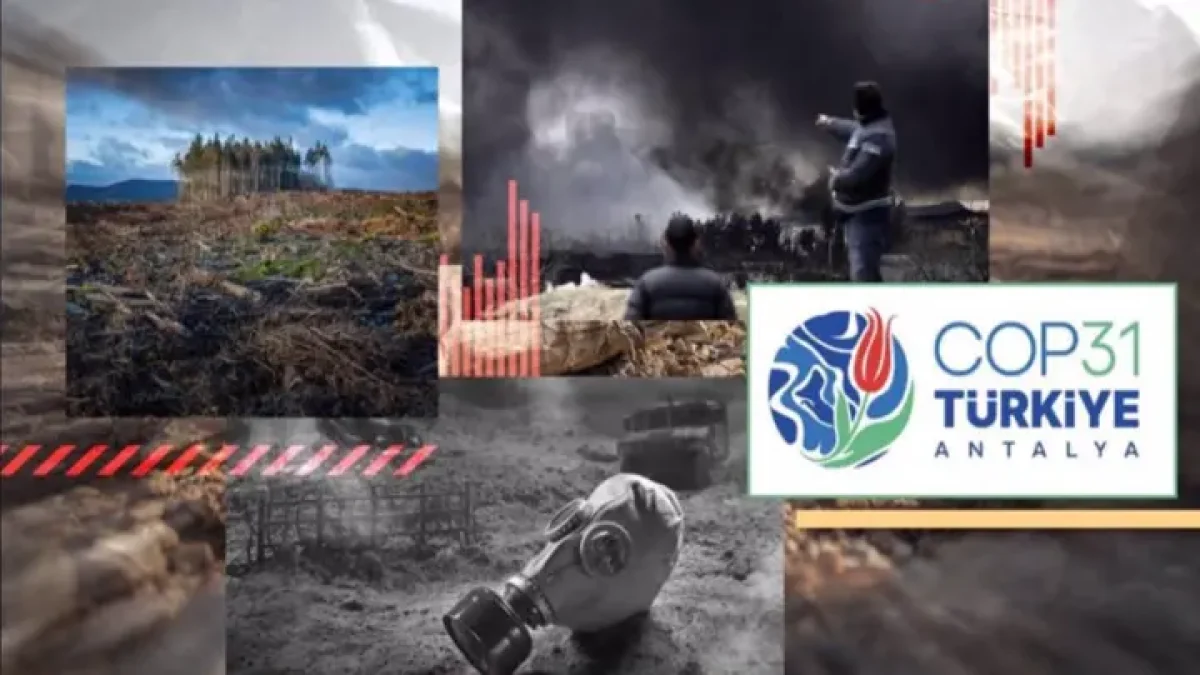
While countries around the world pursue initiatives to curb climate change, the severe environmental pollution and carbon emissions caused by war still receive little attention in formal international negotiations, even as military conflicts in Iran, Gaza and Lebanon inflict long-term damage on ecosystems and natural resources.
At the ongoing UN climate summit COP31 in Antalya, Turkey, the formal agenda includes no dedicated item on the environmental toll of war, despite vast greenhouse gas emissions from bombings, fuel consumption, weapons production and transport, infrastructure destruction and post-war reconstruction.
Heavy carbon emissions reported from strikes on Iran
Addressing COP31, Iranian President Masoud Pezeshkian warned that the environmental destruction of war outlasts the fighting itself, saying US and Israeli strikes on Iranian energy facilities released massive quantities of pollutants and greenhouse gases. According to assessments cited in his speech, strikes on energy facilities in Asaluyeh in southern Iran released about 5,00,000 tonnes of carbon dioxide, while attacks on fuel depots around Tehran emitted another 10,00,000 tonnes.
Iranian Department of Environment adviser Ali-Mohammad Tahmasbi Birgani estimated preliminary environmental damage from the 12-day war in 2025 and the 40-day conflict in 2026 at around 250 trillion rials (about $92.6 million), covering forest damage, wildfire emissions, air pollution and ecosystem restoration, alongside oil pollution near Lavan Island and the coral habitat of Shidvar Island in the Persian Gulf following April strikes.
Devastation of soil, water and farmland in Gaza and Lebanon
A 2025 assessment by the UN Environment Programme (UNEP) found that by May 2025, 97.1 percent of tree crops, 82.4 percent of annual crops and 95.1 percent of scrubland in Gaza had been damaged, while all wastewater treatment plants were out of operation, contaminating groundwater and coastal waters. Speaking at COP31, Turkish President Recep Tayyip Erdogan highlighted the destruction of centuries-old olive trees and water systems in Gaza. A study published in the journal One Earth estimated that the first 15 months of the war in Gaza generated about 3,32,00,000 tonnes of carbon dioxide equivalent. In southern Lebanon, Israeli strikes and the reported use of white phosphorus have burned forests and farmland and forced reliance on polluting diesel generators.
Gaps in military emissions reporting and accountability
The Conflict and Environment Observatory (CEOBS) noted ahead of COP31 that transparency around military emissions is declining: the world’s two largest military spenders, the United States and China, omitted military emissions data from last year’s reports, while summit host Turkey reported military emissions as ‘not occurring’ despite spending about $25 billion on defence in 2024.
Under the UN climate framework, there is still no agreed international mechanism to measure conflict emissions, assign responsibility — including to arms suppliers and financiers — or secure compensation. Analyst Nikita Gryazin of the European Leadership Network has urged COP31 to establish regular dialogue and accounting methods for military emissions, while Lebanese Environment Minister Tamara Elzein instructed her delegation to table proposals on the full climate footprint of war, following earlier interventions by Jordan at COP29, Palestine at COP30, and Yemen and Somalia on fair access to climate finance.
বাংলায় মূল প্রতিবেদন পড়ুন · Read the original Bengali report