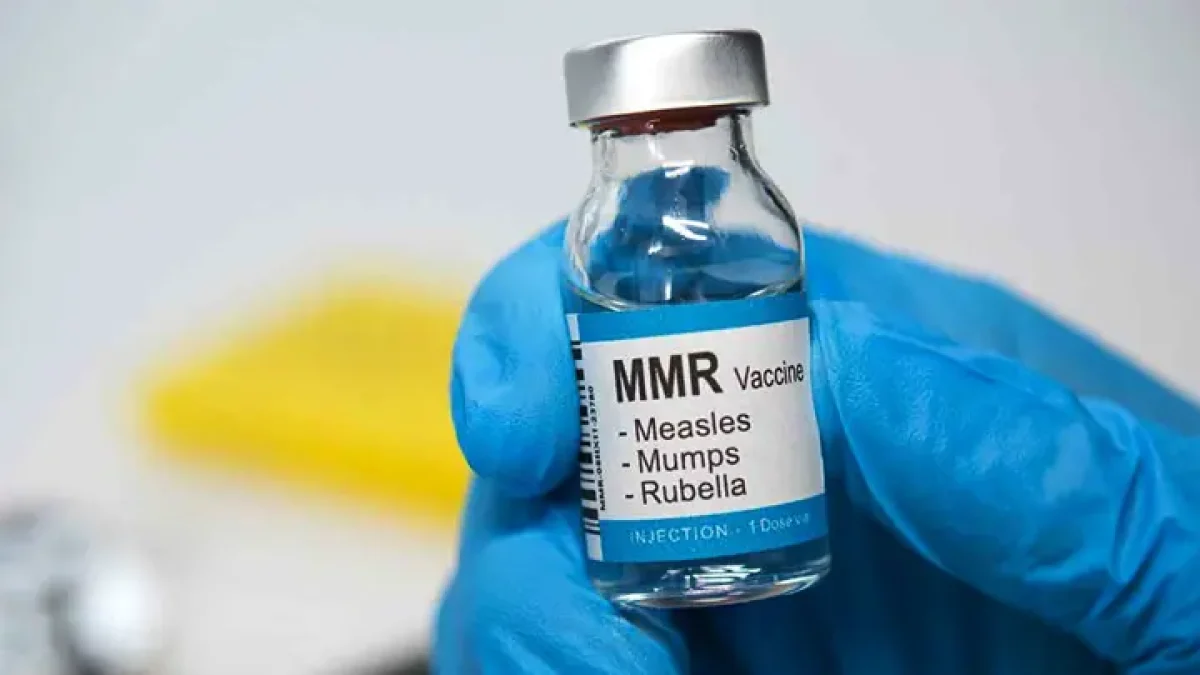
Seven months after the measles vaccination campaign, children are still dying. On average five to six children die every day, and more than a thousand are infected. According to the Expanded Programme on Immunization (EPI) of the Directorate General of Health Services, about 1.9 million children in the country, eight percent of all children, are still outside measles-rubella vaccine coverage, Amar Desh reports.
Experts believe the real number of unvaccinated children is higher. They say mismanagement of the vaccination programme and the large number of children left out are keeping the risk of infection high, so the death toll keeps growing. If the number of unvaccinated children keeps rising, infection could spread on a large scale again in a few years, because at least 95 percent of children must be vaccinated to prevent measles. Below that, the necessary herd immunity does not form. At the same time, many children are not developing enough immunity even after vaccination. In this situation, experts have urged stronger disease surveillance and epidemiological analysis.
Campaigns delayed again and again
The country’s first measles-rubella vaccination campaign began in 2006. Three more followed, in 2010, 2014 and 2020. The next was due in 2024 but was put back to 2025, and in the end that was postponed too. Meanwhile, from 2023 to 2025, 42 percent fewer vaccines were bought than were needed.
At a meeting on 8 September 2022 it was decided that the cost of routine EPI vaccines would be met from the revenue budget instead of the development budget. After the interim government took office, it moved to drop the sector programme and shift most spending to the revenue budget. This disrupted vaccination on schedule. When measles spread widely in mid-March this year, a special vaccination programme began on 5 April in 30 upazilas and municipalities of 18 high-risk districts. It was later extended to several city corporations, and a nationwide campaign ran from 20 April to 20 May.
Under the routine EPI schedule, children receive the first measles dose at nine months and the second at 15 months. To tackle the outbreak, however, the national technical committee recommended lowering the starting age from nine months to six months. By EPI’s count there are 18 million children aged six months to five years, and the campaign began with that target.
After the nationwide vitamin A campaign began on 28 June, confusion arose over the number of children in the same age group. That campaign set a target of giving vitamin A capsules to 22.6 million children aged six months to five years. The gap between the two programmes’ counts of children of the same age was 4.6 million, which raised questions.
On 26 September a special measles-rubella campaign was launched to vaccinate 3.4 million children who had been missed. It ended on 31 October. At the launch, Health Minister Sardar Md Sakhawat Hossain said about 4.3 million children had been left out of the earlier campaign. A mop-up campaign had since vaccinated another 1.9 million, leaving 2.4 million. To these were added another 1 million children who had turned six months old in the past three months, for a total target of 3.4 million.
According to EPI, 21.65 million children had received the measles-rubella vaccine as of 4 November, more than the target, for coverage of 120 percent. But measured against the 23.5 million children counted in the vitamin A campaign, about 1.9 million are still unvaccinated.
Mymensingh ahead, Sylhet behind
By division, Mymensingh is furthest ahead in vaccination, with 1.65 million children vaccinated. In addition, 5.3 million children were vaccinated in Chattogram, 2.3 million in Rangpur and 5.35 million in Dhaka, including 1,069,096 in the Dhaka North and South city corporations. About 1.3 million were vaccinated in Barishal, more than 2.4 million in Rajshahi, 1.85 million in Khulna and more than 1.5 million in Sylhet. EPI could not say how many children were missed in each district.
An EPI survey found that 91 percent of children who died of measles and 80 percent of confirmed cases had received no MR vaccine. Among children under six months, the shares of cases and deaths were 10 percent and 20 percent. For those aged six to nine months the figures were 18 and 31 percent; for nine to 12 months, 12 percent of cases and 25 percent of deaths; and for one to five years, 28 percent of cases and 18 percent of deaths.
On the children missed, EPI deputy director Dr Mohammad Sabbir Haider told Amar Desh that the age for the measles vaccine is six months. Any child who turns six months can be vaccinated, and it is a continuous process, he said.
Many children under six months are also being infected and dying, he said. This shows they are not getting the expected immunity and protection from their mothers, and there may also be nutritional deficiencies. Many adolescent girls and young women who missed vaccines during the coronavirus pandemic are now becoming mothers, so newborns without the protection of maternal antibodies are also at risk of measles.
Dhaka division leads in deaths and cases
The country recorded 132 measles cases in 2025, against 247 in 2024, 282 in 2023 and 311 in 2022, with no deaths recorded in that period. Now more than a thousand children have died of a disease that had nearly disappeared.
According to the Directorate General of Health Services, 1,282 children died of measles or measles symptoms between 15 March and 8 November. Of them, 105 died of measles and the other 1,177 with measles symptoms. In the same period 263,282 people were infected. Dhaka division had the most cases of measles and measles symptoms, 115,046, or 43.7 percent of the total. It was followed by Chattogram with 51,210, Barishal 26,420, Sylhet 22,106, Khulna 16,787, Rajshahi 13,205 and Mymensingh 13,257, with 5,251 in the remaining division. Dhaka division also had the most deaths, 597, or about 46.6 percent of the total, followed by Sylhet with 209, Chattogram 124, Rajshahi 96, Mymensingh 92, Barishal 89, Khulna 57 and Rangpur 18.
Why is it not under control?
Measles spread among children at epidemic levels from mid-March. Despite efforts to control it through vaccination, the situation has grown more complicated by the day, and some now ask whether measles will be with us for good.
Experts say gaps in routine vaccination, malnutrition, vitamin A deficiency, late treatment, administrative weakness and poor surveillance have raised children’s risk of death. The political situation, repeated protests by health workers and the failure to prepare properly despite warnings have also pushed the situation to a critical stage. Recent research by the Institute of Epidemiology, Disease Control and Research (IEDCR) and other bodies found that many children did not develop antibodies even after vaccination and that the vaccine is not working properly.
Vaccine expert Dr Tajul Islam A Bari said that because of poor coordination many children did not get both doses on time. A dose given at six months is 50 percent effective, and at nine months about 85 percent, he said, though no vaccine is 100 percent effective. In the present situation all children aged six months to 15 years should be vaccinated, he said.
“We always have to depend on foreign countries to import vaccines,” he said. There are serious weaknesses in the vaccination system, including cold chain monitoring, storage and transport, and no system to check quality properly, so the government must rethink vaccines and the vaccination system, he said.
Public health expert Dr Mushtuq Husain called for research into why children are getting measles even after vaccination. Had a public health emergency been declared in time and effective steps taken, many children’s lives could have been saved, he said. Such deaths and infections have been seen nowhere else in the world, he said.
Administrative negligence to blame: health state minister
Questioning why routine measles vaccination was halted during the interim government and why emergency vaccines were not imported, State Minister for Health Dr M A Muhit said extreme administrative negligence and irresponsibility lay behind it. A three-member committee has already begun investigating to identify those responsible and ensure accountability, he said. Voicing anger at a recent event, the minister said the country needs to know who took such irresponsible decisions and why the necessary vaccines were not imported.
বাংলায় মূল প্রতিবেদন পড়ুন · Read the original Bengali report