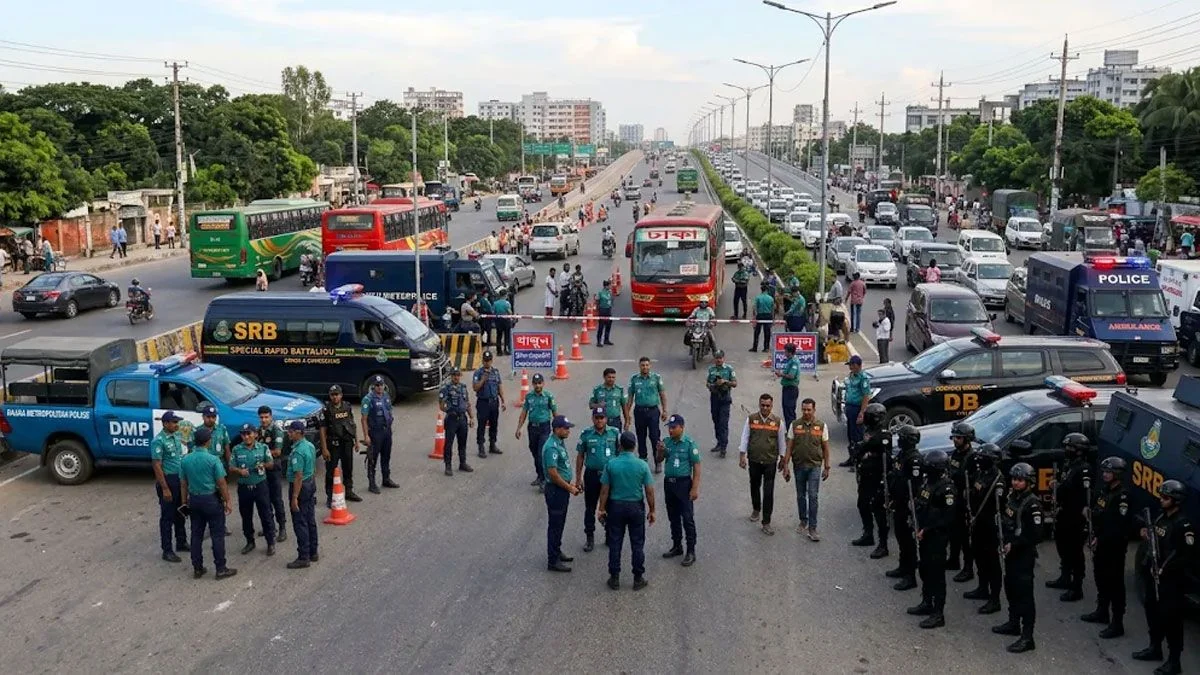
Tension has risen over the announcement by Sheikh Hasina, the prime minister ousted in the July uprising and now in India, that she will return to Bangladesh. Covert activity by leaders and activists of the Awami League, whose activities are banned, along with flash processions, cocktail blasts and rumours and scare stories spread on social media, are frightening ordinary people. A string of recent violent incidents and acts of sabotage attributed to the party has alarmed the public. Citizens are worried by arson attacks on vehicles and cocktail blasts outside government offices and in crowded areas, and some parents are afraid to send their children to school.
Against this background, the government has taken a firm position to stop sabotage by the banned party and to ease public fear. It has said plainly that there is no room for leniency towards the ousted prime minister. She has been sentenced to death over the killings during the July uprising, and the government says it is following the existing extradition law and judicial process to bring her back to face justice. It has asked the Indian government for help on the matter.
The security forces have announced that anyone who tries to destabilise the country or threaten public safety under cover of a political identity will be dealt with under a “zero tolerance” policy. The government has rejected Sheikh Hasina’s applications for a new passport and national identity card (NID), which officials see as a firm legal and administrative message to her.
Farooq Ahmed, director general of the Special Response Battalion (SRB), said police and the SRB are working together to maintain law and order around December. Those involved in bomb or cocktail attacks are being brought to justice quickly, he said: whoever is involved in such incidents will not be spared, and all of them will be targeted and caught.
Sources at the home ministry said the law and order situation across the country is being closely monitored. All units of the security forces, including the police and the SRB, have been given strict orders to catch saboteurs. Many people have already been arrested over cocktail throwing, arson and intimidation, and efforts continue to identify and arrest others involved. Action has also been stepped up against individuals and groups spreading rumours online and on social media to cause public panic.
To keep the economy moving and maintain overall security, additional members of the security forces and the Border Guard Bangladesh (BGB) have been deployed in key industrial areas including Dhaka, Gazipur and Narayanganj, so that nobody can exploit labour unrest or sabotage for their own ends.
According to the Dhaka Metropolitan Police (DMP), 33 people were caught red-handed in a 48-hour special drive around cocktail blasts, arson on vehicles and checkpoint searches in various parts of the capital. Nine of them were directly involved in cocktail blasts, and the rest were arrested during checkpoint searches and over other incidents. Security forces seized a number of unexploded cocktails, materials used in the blasts and motorcycles used to move around.
Beyond the specific cocktail and sabotage cases, the DMP’s regular and special drives are arresting four to five hundred criminals and people named in warrants every day. Police said most of those arrested are linked to the banned political party.
To keep the situation fully under control, intelligence surveillance and searches have been stepped up at every entry point to the capital, at key locations and in sensitive areas.
DMP commissioner Moslehuddin Ahmed said visible patrols, checkpoints and searches by the police and other forces have been increased to remove public fear and let ordinary people move about with ease. There is close watch on misinformation and propaganda spread to undermine law and order, he said, and with coordinated action by the security forces, intelligence surveillance and visible security, the situation is fully under control.
A high-level committee and several sub-committees have been formed under Police Headquarters to review the law and order situation and strengthen internal coordination. These committees are monitoring the situation across the country. A smart tracking system has been put in place to catch offenders, action is being taken on intelligence, and the use of modern technology to gather advance information has been increased. Drones and CCTV cameras are being used at key points to watch for suspicious movement.
People familiar with the matter say relations between Bangladesh and India came under serious strain after the ousted Sheikh Hasina took refuge in India on 5 August 2024, and diplomatic ties fell to a low point. Diplomatic analysts say that after Dinesh Trivedi took up his post as India’s high commissioner in Bangladesh, relations improved somewhat and India resumed all types of visas for Bangladeshis. But the situation began to worsen again after Sheikh Hasina held a virtual press conference with the media in Delhi on 5 August this year, and her announcement that she will return in December has added a new dimension to the strain. Analysts say the question of Hasina’s extradition is now more political than diplomatic.
Former ambassador Mahfuzur Rahman told the media: “Frankly, we do not know at present what kind of talks are going on between the two countries. Whether there is strain in the relationship, and if so of what kind, none of it is clear. But it is clear that there is hostility in the political relationship between the two countries.”
He said that after India’s new high commissioner arrived in Dhaka and began approving visas, relations seemed to be gradually returning to normal. “Then on 5 August it stumbled again when Sheikh Hasina held a press conference in Delhi, and since then the whole matter has become completely opaque. The two governments have each said different things at different times. I think the public fear people talk about comes from this lack of transparency and clarity. Both governments bear responsibility here, so the matter needs to be made clear at the level of the relationship.”
বাংলায় মূল প্রতিবেদন পড়ুন · Read the original Bengali report