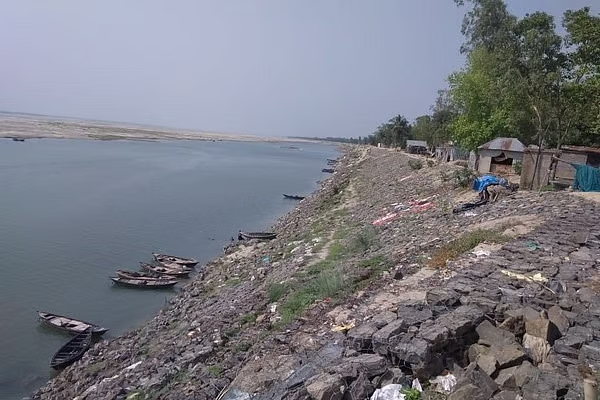
Erosion by the Ganges is one of the greatest curses of Malda district in India’s West Bengal. Over decades the river’s devouring course has left more than a hundred thousand people homeless. Two campaign groups from Bengal and Bihar demanding action against the erosion recently toured an area of about 20 kilometres together to assess the situation.
Activists of Bihar’s Ganga Mukti Andolan and Malda’s Ganga Bhangan Nagarik Action Pratirodh Committee inspected the area by boat and on foot, from Panchanandapur and Sultantala to Gopalpur and Kamaldipur. The team included activists Mahendra Badal, Yogendra Saini, Udayji, Tariqul Islam, Khidir Box and Sanjay Basak. They saw for themselves which villages are at risk and how far east the river has moved.
In the past, erosion struck many areas such as Rajnagar, Birnagar, Parlalpur, Panchanandapur and Gopalpur, robbing local people of their sleep. About 22 years ago, the KB Jhaubona gram panchayat between the Manikchak and Baniachak blocks was swallowed entirely by the river. In 2003 the historic Ganga Bhavan also disappeared into the river. Having lost these places, people are now looking only for a permanent solution.
After the inspection, the two groups said plainly that trying to stop erosion only in the Bhutni area would achieve nothing. Dredging the main channel, or middle stream, of the Ganges from Bhutni to Farakka would deepen the river, they said. They also proposed removing an extra 200 to 300 tonnes of silt and depositing it on the eastern bank through pipes.
The inspectors believe that dredging the river, not temporary work by the irrigation department such as dumping stones or bamboo, is the only permanent remedy for erosion.
Various sources say that removing silt or dredging at different points on the Ganges is being considered for inclusion in the upcoming India-Bangladesh Ganges treaty. A source familiar with the treaty told Prothom Alo that India may this time ask Bangladesh to pay for removing silt from the Ganges. The matter is reportedly still under discussion.
A memorandum setting out a permanent solution was handed to the general manager of the Farakka Barrage Project. The campaigners say previous governments only made promises in the name of stopping erosion and did nothing of substance, but that they have full confidence in the present government.
Uday Yadav, head of the Ganga Mukti Andolan, said that because the river flows through several states, all of them must sit at one table and tackle the problem jointly and scientifically. The state’s chief secretary recently gave an assurance that all the states would work together under central coordination. On the strength of that assurance, people in the erosion-hit areas hope they may at last be protected from the Ganges for good.
বাংলায় মূল প্রতিবেদন পড়ুন · Read the original Bengali report