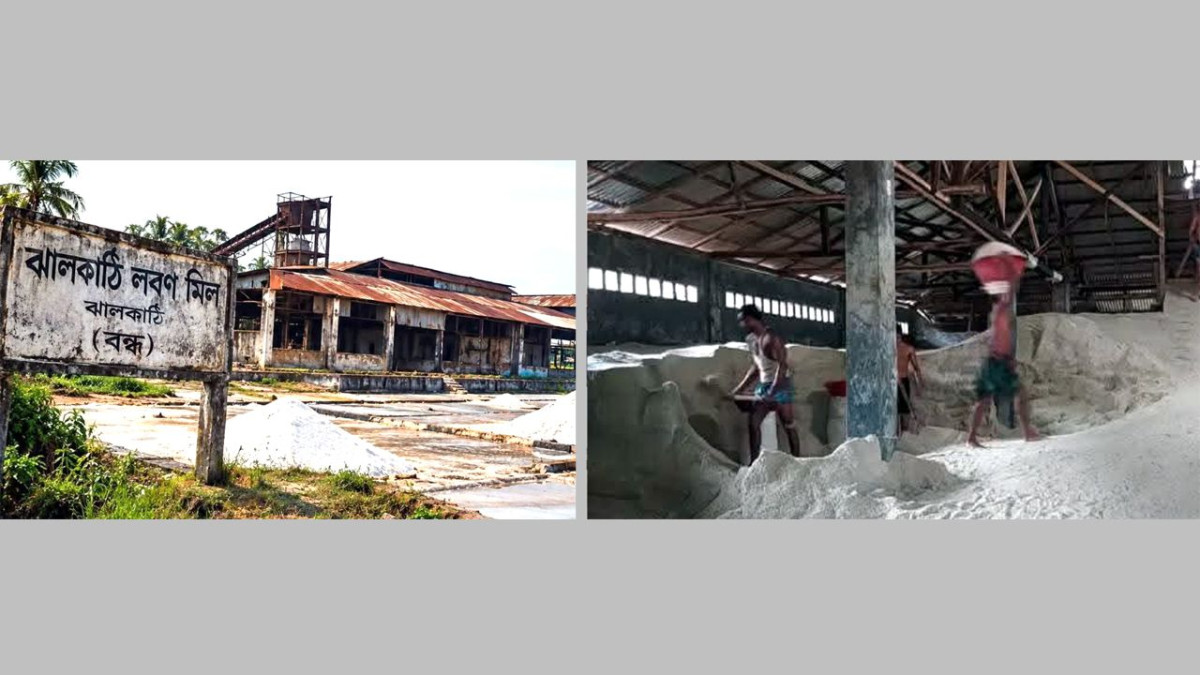
The century-old town of Jhalakathi was once known as a second Kolkata as a commercial river port. Salt industry was the main reason. But as one salt factory after another has closed, the industry has now reached the brink of collapse.
Because of the spread of the salt industry, the coastal district of Jhalakathi in the south was known beyond Bangladesh and in neighboring countries as well. That reputation has faded as local producers have struggled to compete with companies using modern technology. Still, despite various adversities, Jhalakathi’s salt mills continue to produce salt worth Tk 200 crore a year.
Because of easy river communication, 17 salt factories were built one by one on both banks of the Basanda River from the British period. At that time, large sampan boats and trawlers could be seen along the Basanda. They are no longer visible. As the district was once a major center of trade and commerce, it was called a second Kolkata. Jhalakathi port also earned status because of the spread and tradition of the salt industry.
Salt here is produced through traditional methods. Raw salt is brought from Cox’s Bazar and Chattogram and refined. In several stages, the water-mixed salt grains are dried and loosened in resin machines through traditional methods. Salt suitable for different industrial uses is produced. Iodine is then added in proper quantities, and the salt is packaged and marketed. Jhalakathi’s salt industry fell behind when modern technology began to be used in salt production in the 1980s.
Sources said that of Jhalakathi’s 17 salt mills, 10, including Mitali Salt, Nur Salt and Surabhi Salt, have closed. Seven mills, including Sharif Salt and New Jhalakathi Salt, are currently surviving.
People involved in the sector said that although competing with modern companies is difficult, salt production here has doubled compared with earlier levels. While salt from large companies sells at retail for Tk 35 to Tk 40 per kg, Jhalakathi salt sells for Tk 20 to Tk 22. Because the price is lower, wholesalers from nearby Rajshahi, Pabna and Kushtia come to buy salt from the area.
Al Amin, deputy manager of BSCIC in Jhalakathi district, said the agency is providing all kinds of support to maintain the quality of the salt industry. BSCIC is always beside the industry to keep it alive and modernize it, he said.
Md. Jamal Sharif, general secretary of the Jhalakathi District Salt Traders Owners Association, said the tradition of the domestic salt industry can be preserved if pipeline gas supply and necessary banking facilities are ensured so producers can survive in competition with modern auto-mill companies. The owners’ association is also considering a new wage structure for workers. He said the lost tradition of the domestic salt industry can be restored if capital and overall government support are provided, salt imports from abroad are stopped and pipeline gas supply is made available.
বাংলায় মূল প্রতিবেদন পড়ুন · Read the original Bengali report